



I restarted my consulting and advisory practice ten months ago. I’m having a lot of fun, learning a lot, and the time-boxing of consulting work allows for time to dedicate to continuing education, networking, certifications, writing, and developing new skills — something I believe is critical in this new age of AI that is rapidly changing the way we approach work. I’m lucky enough to have my practice while I have conversations and look for my next full-time role. The option to be picky is a luxury, and it’s not one I take for granted.
About six months ago, I joined Chief (yes, I know, that’s a topic for another time) but since networking has never come naturally to me, I determined it was a sound investment. Upleveling and all that. Fast forward to a few weeks ago, I put out a call to my other Chief members for recommendations on a career coach — I’ve always had difficulty reaching out for help, and I thought, naively or not, that Chief would be a decent place to start. A few names were shared with me, and it’s an interaction with one that inspired this post.
I connected with this coach on LinkedIn, sent the “Hi, I was referred to you” email, explained a little about what I was hoping to accomplish, and attached my resume.
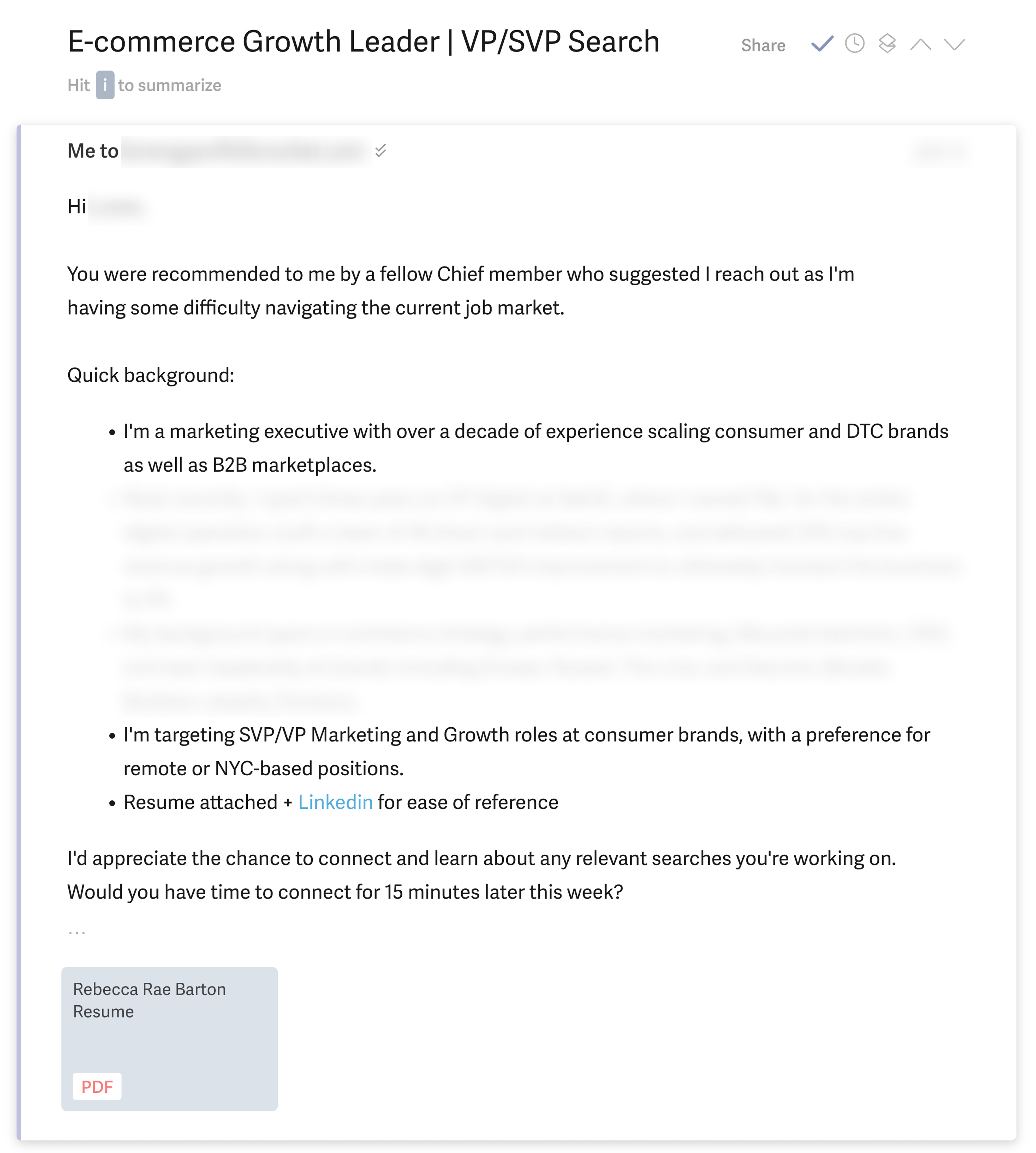
Normal, right?
The response I got was... interesting.
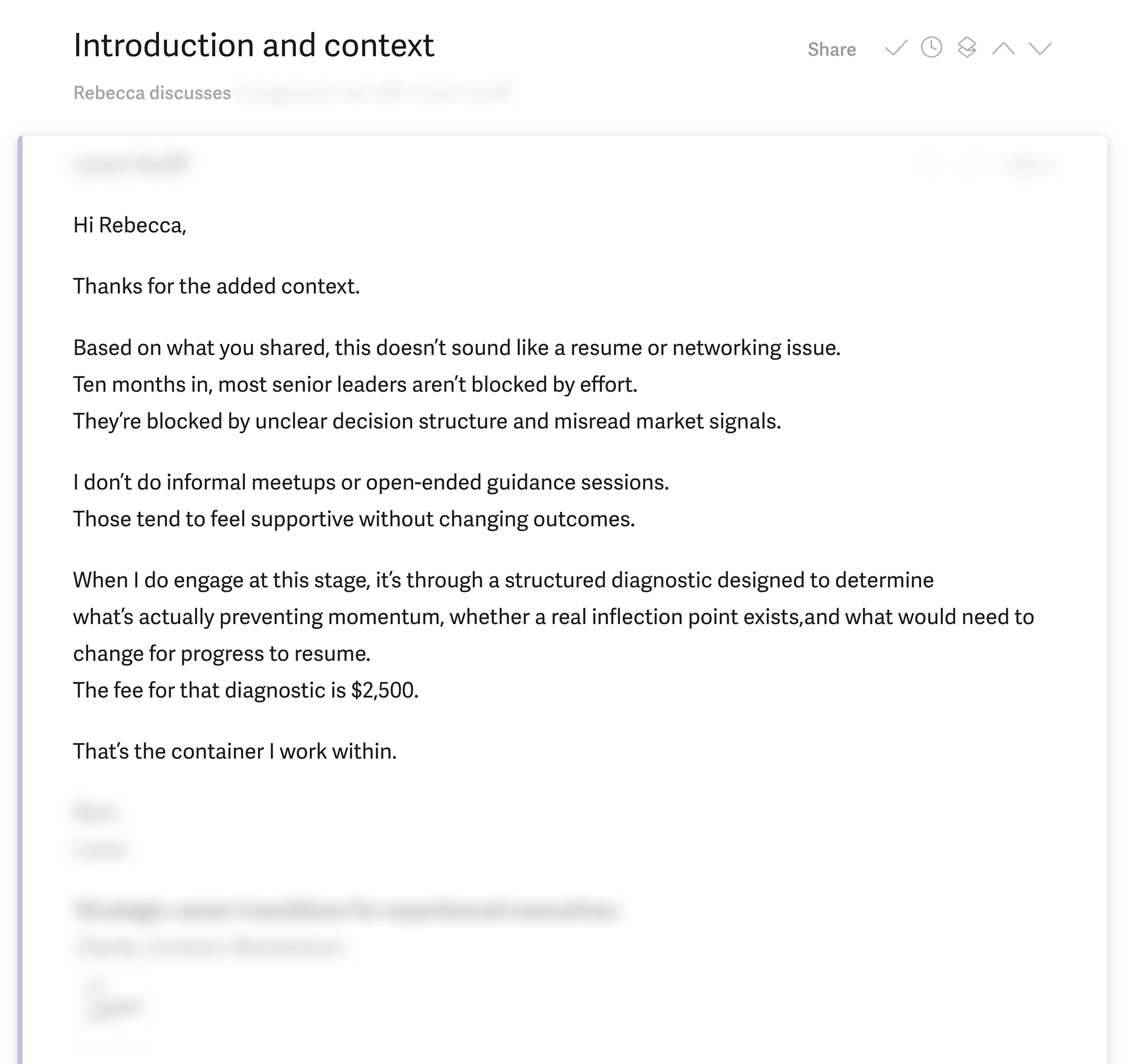
Something felt off, so I declined, and it was the response that I got back confirmed every instinct I had.
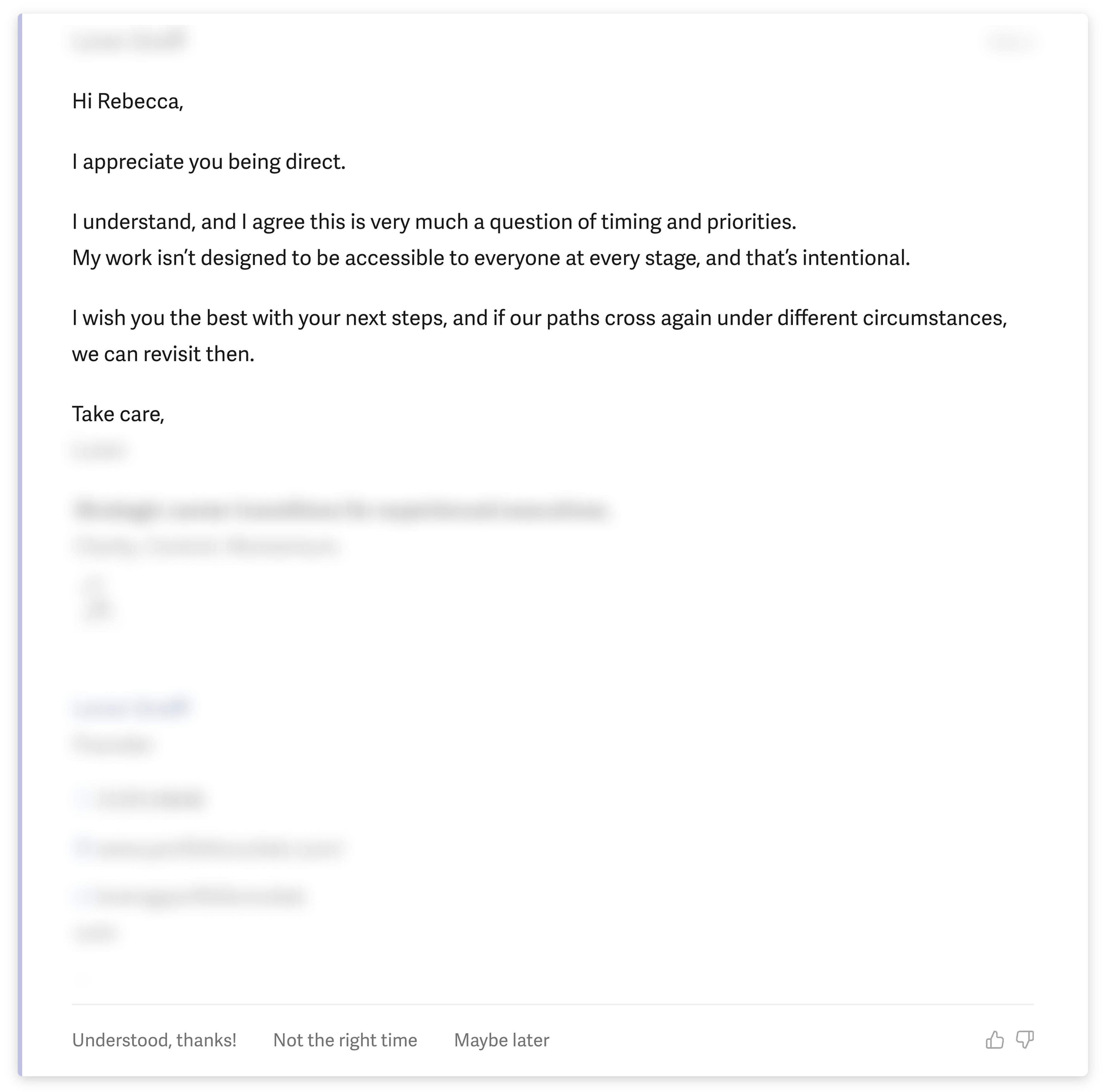
The blatant high-pressure sales tactic, the qualifying out, the artificial scarcity and exclusivity, the attempt at triggering loss aversion, and topped off with some manipulative “priorities” framing. The implication that if I don’t buy, I don’t value my career or growth or future. A conspicuous guilt lever disguised as insight.
Girl, ew.
Noticeably absent was any attempt to understand my situation. No demonstration of her relevant expertise or explanation of what her ‘diagnostic’ fee actually buys. The attempt to make me feel like I’m not good enough for the cool kids’ table... yet. A particular brand of negging I have never experienced in a professional setting and never would have expected from a referral in a women’s leadership group, member to member.
Here’s the thing: I’m not writing this because I fell for it. Her methods certainly worked, because I’m feeling a certain way, but I’m writing this because I know how many people might, especially in a job market as opaque and volatile as the one we’re currently in.
The Red Flags
Let’s start with the facts she conveniently ignored — facts I’d like to remind you of, dear reader:
The average executive searches are *long*, and that’s completely normal. Multiple executive search firms report that the average executive search lasts roughly 10 months. VP roles take 4-6 months minimum. C-suite can stretch to a year or more.
So when someone tells you that “most senior leaders aren’t blocked by effort” after three months, 6 months, or 10 — as if you’re doing something wrong — they’re either uninformed or manipulating you. Pick which you think is more likely.
There are also a few high-pressure sales tricks you’ll want to keep an eye out for, either from gurus wanting to sell you a program or in your next RFP process with a marketing agency:
Diagnosing problems without information. “Unclear decision structure” and “misread market signals” based on a three-sentence email? That’s not insight. That’s a cold read designed to make you doubt yourself, don’t fall for it.
Dismissing support as worthless. “Those tend to feel supportive without changing outcomes.” Translation: emotional support and human connection don’t matter. Only my $2,500 diagnostic matters.
All-or-nothing gatekeeping. “I don’t do informal meetups.” Legitimate coaches offer consultations. They want to help you, not just qualify you as a lead.
Scarcity as a feature. “My work isn’t designed to be accessible to everyone.” This is positioning exclusivity as value. It’s manipulation dressed up as standards.
She’s Not the First
This coach isn’t an outlier. She’s the third or fourth I’ve encountered in the past year that operates this way — and those are just the ones who came through trusted referrals. My LinkedIn inbox is filled with outreach from others posing as recruiters that are really just gurus looking to sell me their coaching package.
I get it, everyone’s gotta eat, but there’s no reason to be so icky about it.
The executive career coaching industry has a predatory underbelly that specifically targets senior job seekers. The playbook is consistent:
The fees are staggering. We’re not talking $200 for a resume review. Executive coaching engagements routinely run $5,000 to $10,000 upfront, with some packages hitting $13,000 to $30,000 for six months. My $2,500 “diagnostic” was the entry-level shakedown.
The outcomes aren’t guaranteed — and can’t be. Only employers make job offers. No coach controls that. Yet they sell “60-90 day timelines” and promises of “executive presence” and “personal brand” as if these are deliverables. They’re not. They’re vibes dressed up as methodology.
The systems are deliberately vague. Ask what you’re actually getting for $10,000 and you’ll hear about “structured diagnostics,” “repositioning frameworks,” and “market signal alignment.” Push harder and you get nothing concrete — because there’s nothing concrete to give. The ambiguity is the product.
They target vulnerability by design. If you’ve been searching for months, you’re already questioning yourself. Predatory coaches exploit that — using your fear and uncertainty to justify fees that would make you pause if you were employed and confident. One documented case describes a coach quoting $4,000 upfront and demanding immediate commitment, insisting that people who “don’t commit right away usually don’t follow through.” That’s not coaching. That’s a high-pressure sales close.
Remember, the career coaching industry is unregulated.No standardized licensing. No oversight. No accountability. Anyone can hang a shingle and charge whatever the market will bear — and when the market is desperate senior executives who haven’t job searched in years, the market will bear a lot.
If you’re months into a search, you don’t need someone to manufacture new insecurities. You need tactical feedback, peer support, and maybe a therapist who won’t also try to upsell you.
What Actually Helps
Peer support. Other executives in the trenches — whether through communities like Chief or Pavilion or ExecThread or Exit5, a Slack group of former colleagues, or just a few people you trust enough to be honest with. “Yeah, this sucks, and it’s taking me a long time too” is more valuable than any one framework.
Specific feedback. Not vague diagnoses — actual input. A recruiter who’ll tell you what’s not landing. A former colleague who’ll run a mock interview. A trusted peer who’ll say “that story doesn’t make you sound like the leader you are.” Real data, not vibes.
Recruiters who work your level. Executive search firms and retained recruiters understand market signals, compensation benchmarks, and hiring timelines better than any coach who’s never placed someone in your role. Cultivate those relationships.
Free and affordable resources. AI-powered interview prep tools like Superinterviews, networking tools like Happenstance and Clay.Earth.
The Bottom Line
I’m not saying all career coaches are the bad guys out to scam you, but if someone makes you feel small to sell you something, they’re not worth your time.
You’re not blocked by “unclear decision structure.” You’re navigating a tough market with limited roles, long timelines, and a thousand variables outside your control.
Don’t let anyone use your vulnerability against you.
Have you encountered predatory coaching tactics in your job search? I’d love to hear your stories.


Did you enjoy this newsletter?
Please like it by clicking on the ❤️ at the very top or bottom of this post. This really helps get this newsletter recommended to Substack’s recommended shortlists.