


I have 2,264 connections on LinkedIn. I know that because it’s right there at the top of my profile, a number I’ve watched climb for 14 years without once stopping to ask what it actually means.
I’m bad at LinkedIn. I know this about myself. But one of my goals for 2026 was to find my voice here, and I’m currently climbing cringe mountain to do it.
I’m a data-driven person, always have been. I measure everything. So naturally, I built something to measure this too. It turns out LinkedIn knows a lot more about me than I realized — and much more than it tells me.
“It’s Really Difficult to Do This Yourself”
Last week, I was reeling a bit after the third call with a career coach disguised as a recruiter in as many days. A line from one conversation kept echoing through my head: “it’s really difficult to do this yourself.”
Ok, girl. Bet.
So I went deep. The kind of deep where you stare at your own LinkedIn profile until the words stop meaning anything. Five rounds of headline optimization. Version four of my About section. You know the mode. The one where you’re rewriting your career story in 2,000 characters and wondering if “P&L Owner” or “Revenue Leader” is the keyword that gets you past the algorithm.
Somewhere in that process, I requested my LinkedIn data export. Not for any strategic reason. Just curiosity — what does LinkedIn actually have on me?
What came back was a zip file. Seven CSVs. Connections. Messages. Invitations. Company follows. Shares. And two files I didn’t expect: one called `Inferences_about_you.csv` and another called `Ad_Targeting.csv`.
LinkedIn has been making inferences about me — guesses about my demographics, interests, and behavior — and, of course, selling access to those guesses to advertisers. I knew this intellectually. Seeing the actual file was different. There were hundreds of entries. Some accurate, some wildly wrong, all of them opaque. LinkedIn never showed me this. I had to go find it.
Raw Data, Few Answers
The CSVs were dense and, on their own, useless. Raw data without structure. So I did what I’ve been doing a lot lately — I built something.
I wrote a tool that takes your LinkedIn data export and generates 10 interactive visualizations — network maps, message analysis, career timelines, even a comparison of what LinkedIn *thinks* it knows about you versus what your data actually shows. All rendered in standalone HTML files you can open in any browser. No server. No installs. No data leaves your machine.
It took just an hour or so. And it told me more about my professional life than 14 years of using LinkedIn ever did.
How Big Is Your Network, Really?
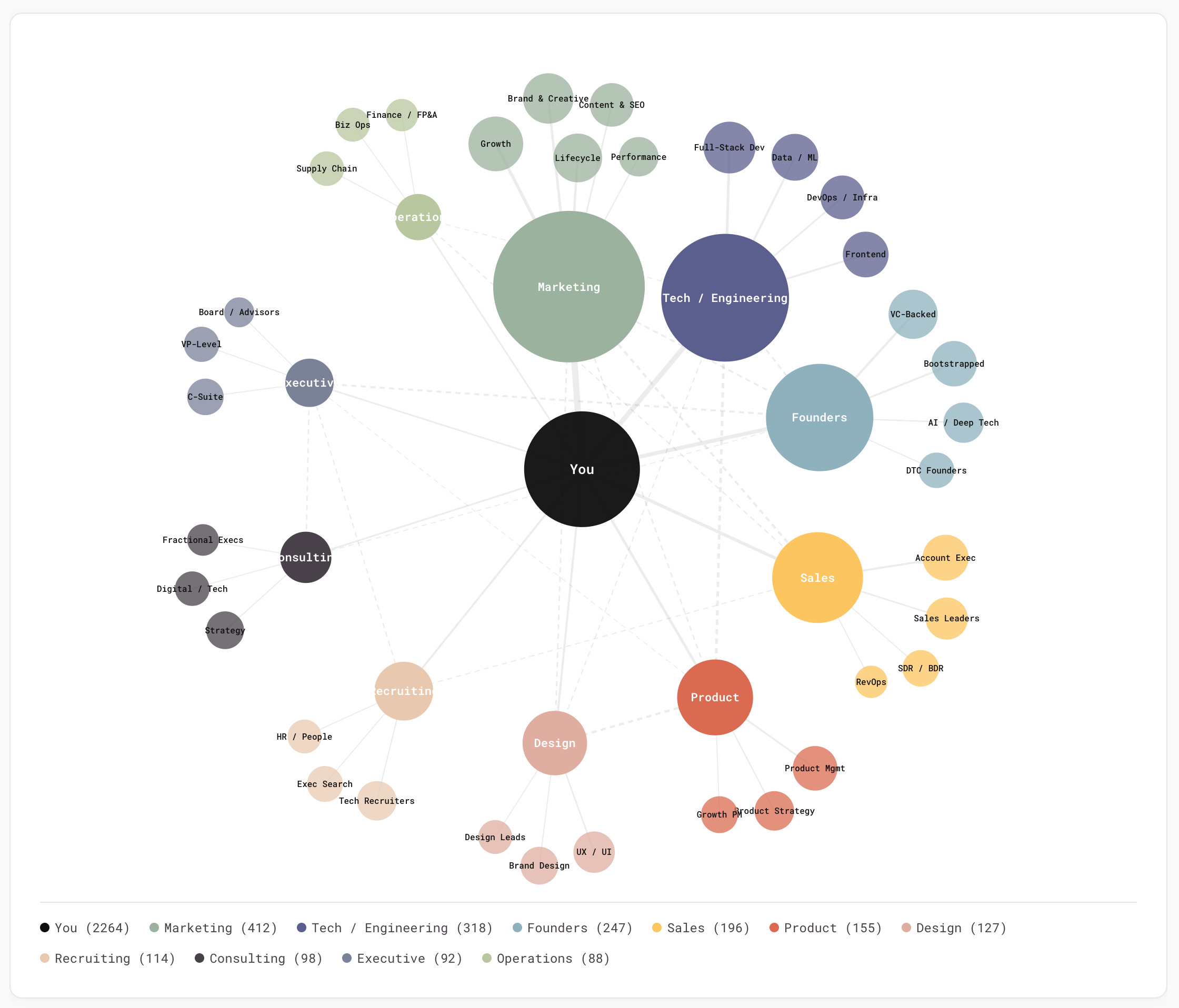
The visualization that hit hardest was Connection Quality. It cross-references every one of your connections against your message history and sorts them into three buckets: Active (you’ve talked recently), Dormant (you talked once, years ago), and Never Messaged.
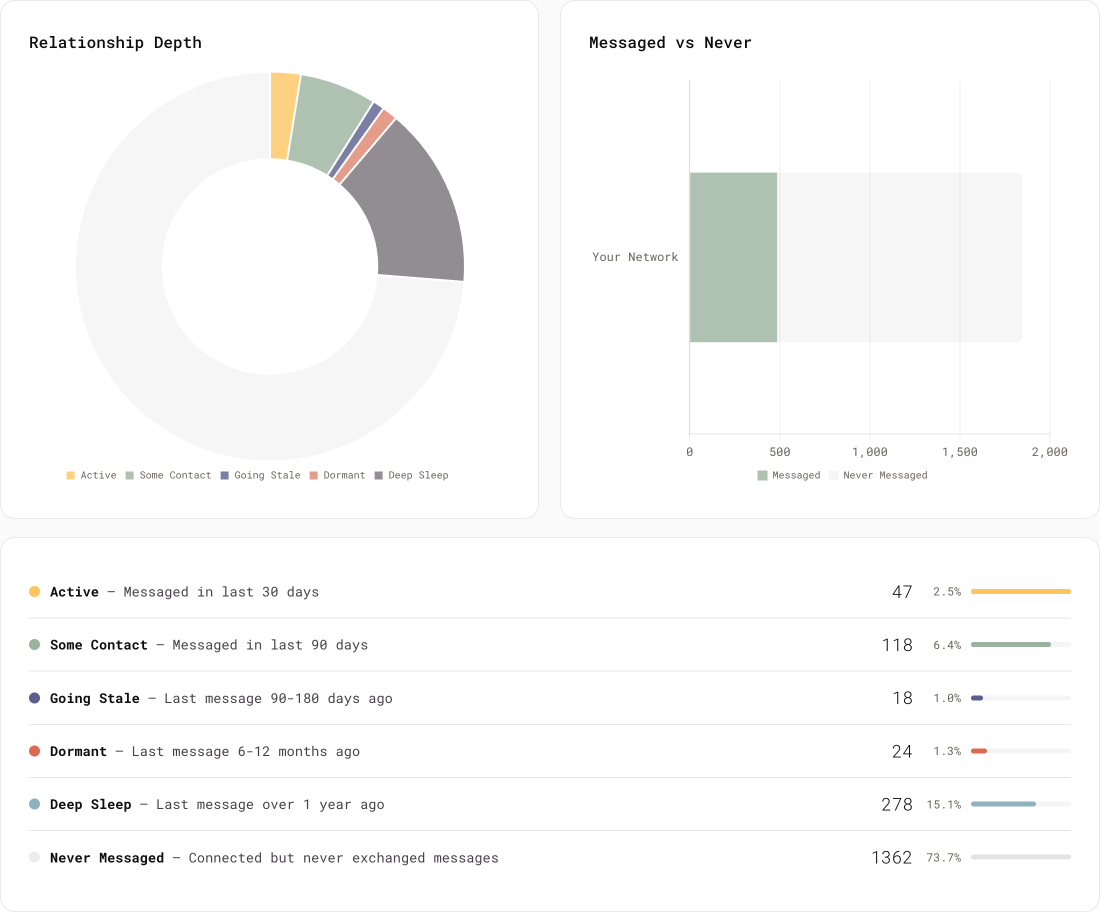
The “Never Messaged” number is the honest answer to “how big is my network, really?”
Mine was humbling. I won’t share the exact breakdown, but I will say this: the number LinkedIn puts at the top of your profile and the number of people you’ve actually had a conversation with are two very different things. We all know this intuitively. Seeing it quantified is something else.
A Career in Strata
The other one that was fun to sit with was Career Strata. It takes your entire connection history, divides it into phases based on when you connected with people, and stacks them like geological layers. Oldest at the bottom. Newest at the top.
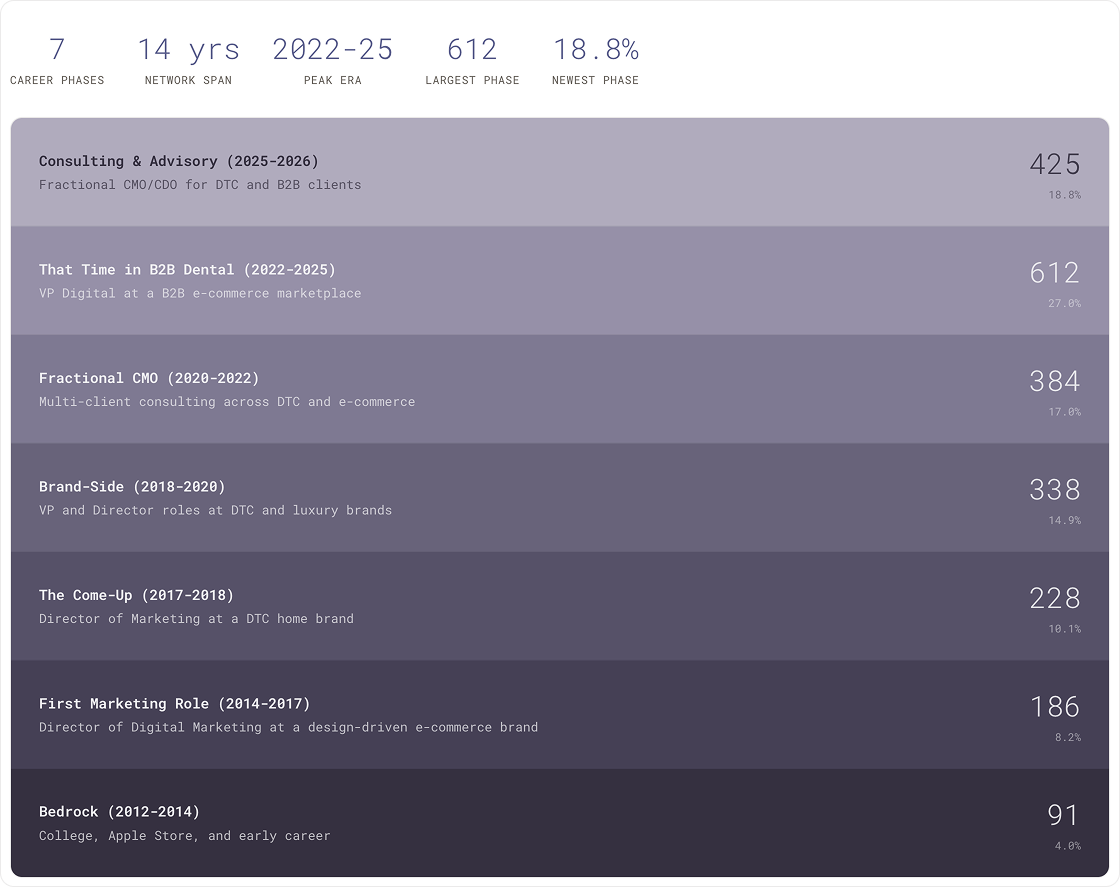
My deepest layer is labeled “Bedrock (2012–2014).” College. The Apple Store in Grand Central. The Tumblr community that started everything.
Above that: The Line, where I went from intern to director. Then Snowe, Paravel, Brooks Brothers. The consulting years. Net32. Each layer tells a story — not through job titles or bullet points, but through the people I was connecting with during each chapter. Where the network was growing. Where I was heads-down and not reaching out at all.
It’s your career, told through the people in it. LinkedIn has had this data for over a decade. They never built this view.
You Are the Product and the Last to Know
One visualization compares LinkedIn’s algorithmic inferences against your actual data. For each guess LinkedIn has made about you, it pulls what your export actually shows and renders a verdict: Accurate, Partial, or Wrong.
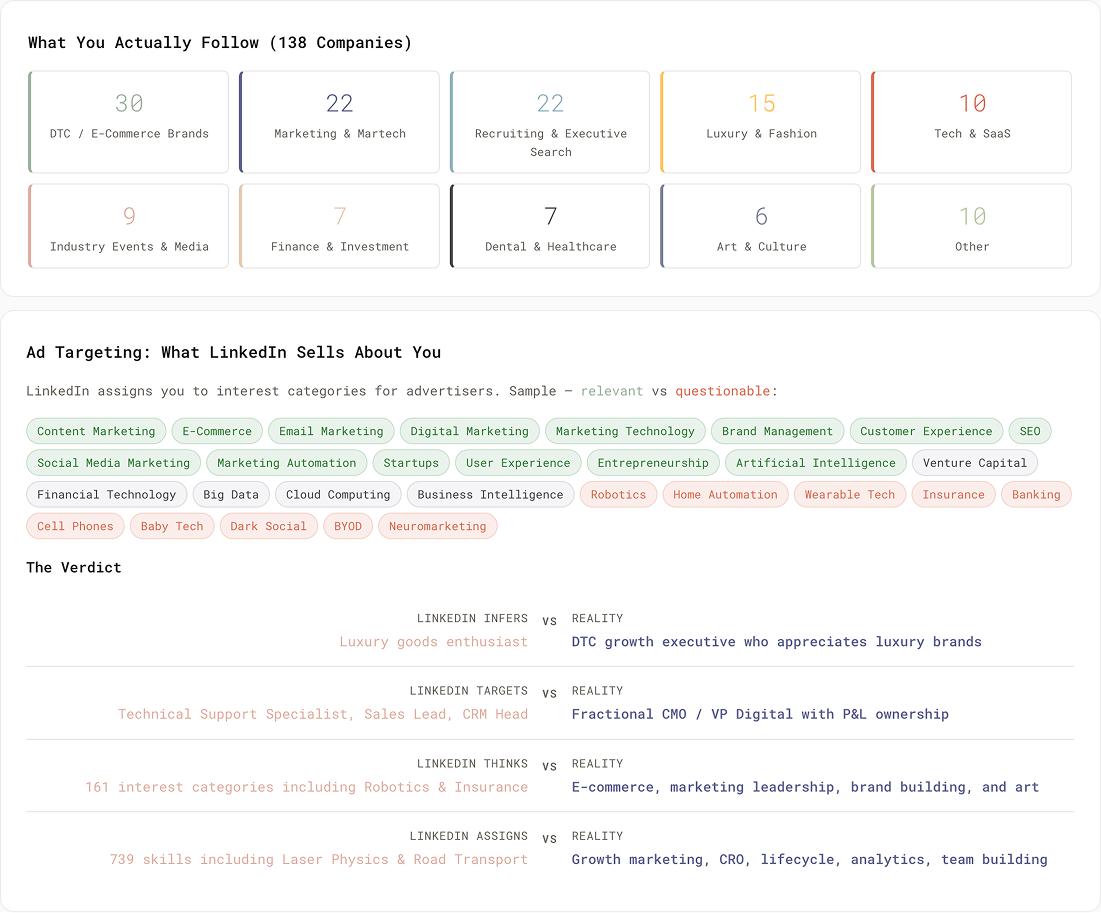
Some of it was fine. Some of it was laughably off. LinkedIn has assigned me 739 skills — including Laser Physics and Road Transport. It filed me under 161 interest categories, among them Robotics and Insurance. It targets me to advertisers as a Technical Support Specialist and a Sales Lead. I’m a fractional CMO who’s spent 12 years in growth marketing. But sure, laser physics.
The point is that LinkedIn is making hundreds of assumptions about who I am, selling access to those assumptions, and never once asking me if they’re right.
This is the data asymmetry that I found most interesting. It’s not that platforms collect data. That ship sailed. It’s that they collect it, analyze it, monetize it, and then hand you back a connection count and a notification that someone viewed your profile. The intelligence flows one direction.
The Questions LinkedIn Won’t Answer
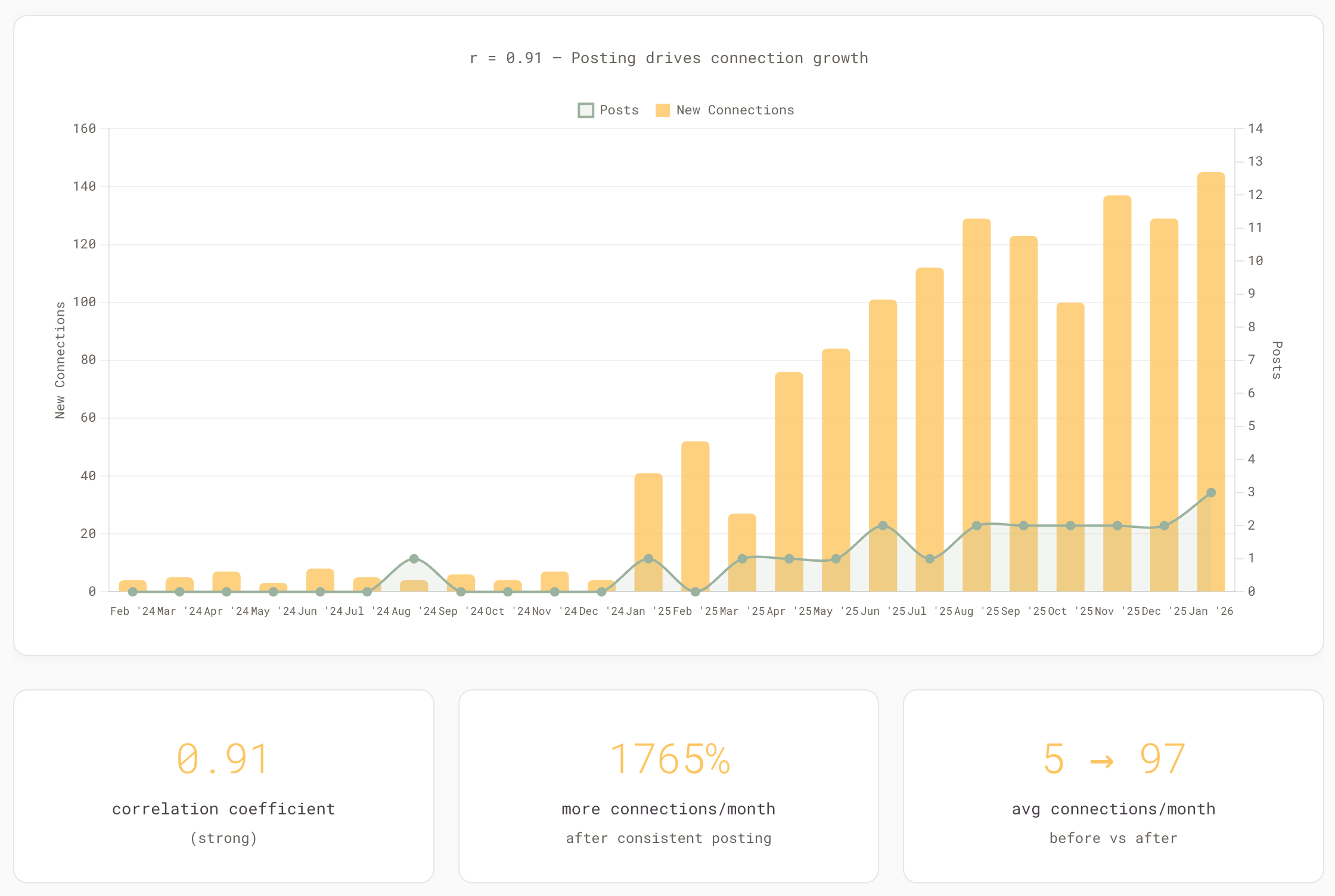
Some of the visualizations answered questions I didn’t know I had. One charts posting frequency against new connection requests. The correlation of 0.91 — nice. In months where I posted consistently, I got 1,765% more new connections than in months where I didn’t. Correlation isn’t causation. But it’s a hell of a data point for someone who used to post once a year.
There are more questions in that data than I’ve built visualizations for. What types of messages actually get responses? Which connections lead to real professional relationships versus permanent dormancy? Is there a correlation between when you connect with someone and whether you ever speak again?
LinkedIn has the data to answer all of these. They just don’t.
The Audacity to Bootstrap
Last fall I wrote about vibe coding and the personal software revolution — the idea that the most interesting thing about AI-assisted development isn’t building the next App Store hit, but building personal tools for an audience of one.
This tool is that idea, made a little more concrete.
I didn’t build this to sell anything. I didn’t build it to launch a startup. I built it because I had a question — what can Linkedin actually do for me? — and the platform didn’t want to answer it. So I built the answer myself, and I built it for you, if you’d like to try it.
To the career coaches sliding in my inbox, attempting to sow doubt, attempting to trigger my loss aversion, and create new insecurities so I’ll hand over a few thousand dollars — I see you.
Yes, it may be difficult to do this myself. Maybe I’ll fail and end up crawling back to one of you.
But what if it works out?
I’ll just keep building and let you know.


Did you enjoy this newsletter?
Please like it by clicking on the ❤️ at the very top or bottom of this post. This really helps get this newsletter recommended to Substack’s recommended shortlists.
Or, if you enjoyed this, learned something new, and it will help you in any way, reply and tell me about it. If you loved it, you can always treat me to a coffee.