


Last week at Shoptalk I sat down for drinks with Adam Ring, and he and I got to talking about performance marketing, what questions we keep getting, why small-to-mid market brands still report on ROAS, and how we’re thinking about the future of attribution and what it means for the marketer. It was that conversation that had me drafting this newsletter on the flight home, because it’s that important and so damn timely.
This week, we’re discussing channel-level attribution, why ROAS is a number you should retire, and how (and why) you should update your performance dashboard to run like a P&L.
Now, on to the post…

The house always wins
In January 2026, Meta deprecated two attribution windows. Reported conversions across the platform dropped 15-40% overnight, depending on the advertiser. The campaigns didn’t change. The audiences didn’t change. Nothing changed about consumer behavior. The measurement changed.
This is the number your CFO saw in the board deck. The one that justified last quarter’s budget and determined which channels got more money. It shifted by double digits because a platform updated a setting.
If your results can evaporate that quickly, I’m sorry to tell you your ROAS number was never real to begin with.
The Meta attribution change was clarifying. It surfaced a problem that’s been structural for years: every major ad platform is both scorekeeper and player. Google reports its own conversions. Meta reports its own conversions. So does MNTN, LinkedIn, Pinterest. When multiple platforms claim the same sale, your aggregate ROAS can exceed reality by multiples.
Analytic Partners’ ROI Genome, across 1,000+ brands in 50+ countries, found that siloed ROAS overstates search performance by 2-10x. Thirty percent of paid search clicks are actually driven by video spend elsewhere in the funnel. Brands optimizing to search ROAS are systematically defunding the channels that create the demand search captures.
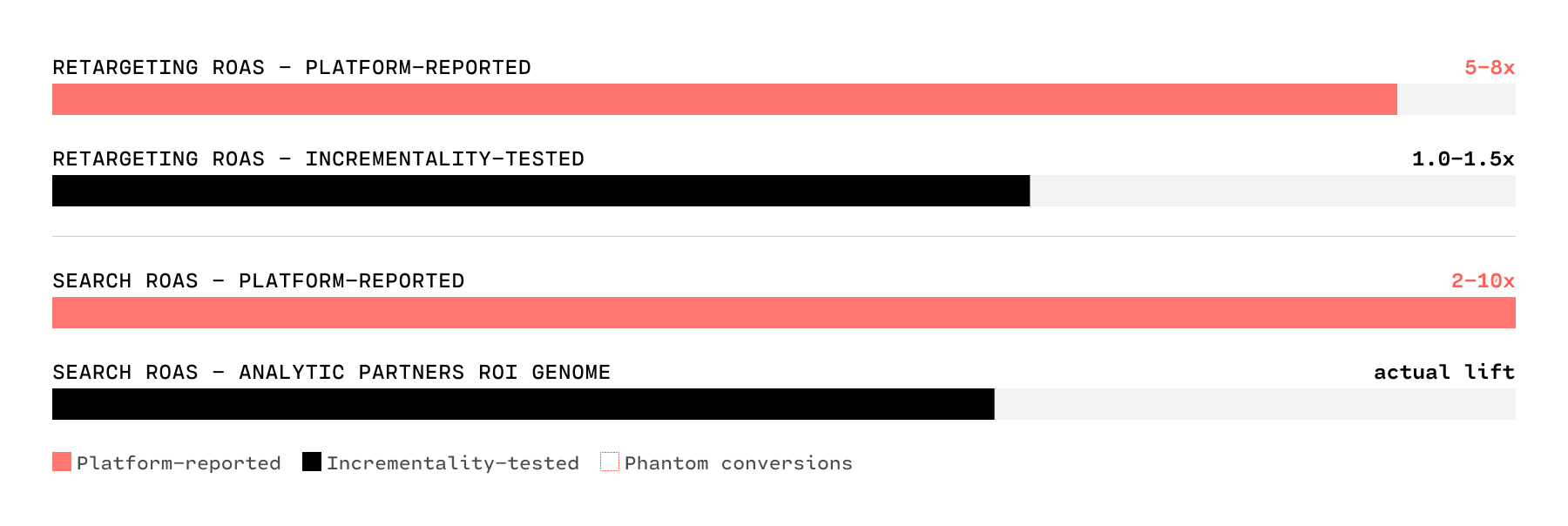
Meta’s retargeting numbers tell the same story at the campaign level. Platform-reported ROAS runs 5-8x. Run an incrementality test and the real number drops to 1.0-1.5x. Retargeting overwhelmingly captures users who were already going to buy. Fifty-four percent of advertisers are still running last-touch attribution models despite all of this.
A few months ago, I wrote about the entropy problem — messy data, broken taxonomies, tech stacks built on institutional knowledge and a prayer. Attribution sits on top of that same mess, and the measurement layer inherited every structural problem underneath it. Then the platforms added a conflict of interest on top.
Kick the bad habit
Why do sophisticated marketing organizations continue to anchor to a number they suspect is wrong? Well... habit, of course.
There’s an academic concept called surrogation: what happens when a measure of a thing replaces the thing itself. The ROAS score stops being a proxy for business growth and becomes the goal. You’ve seen this in action. The meeting where everyone optimizes to the dashboard number and nobody asks whether the business actually grew.
When bonuses are tied to a specific number, say it’s GMV, the human brain will optimize for that number even when it destroys long-term value. We all know that top-line revenue does not a successful business make, don’t we? Sure, but fMRI research shows we process performance measures and strategic objectives through distinct neural patterns: the brain treats a metric like a concrete object and a strategy like an abstract concept, which makes surrogation an involuntary cognitive shortcut. (Seriously involuntary. Like neurologically default behavior.)
The industry has spent a decade surrogating. Each attribution model was adopted as the complete answer: the single scoreboard that would finally settle which channel deserves credit.
Spoiler: The question itself was wrong.
Incrementality or bust
Airbnb cut $541M in performance marketing during 2020, then made it permanent. Revenue grew from $5.99B in 2021 to $12.2B by 2025 while holding marketing spend at 19% of revenue, with the majority in brand. Four years of brand investment built what a decade of performance spend hadn’t.
“The majority of our bookings come from past guests, and it’s actually been the strong guest retention that we’ve had for years since the beginning of Airbnb that’s been a powerful driver of our growth.”
Dave Stephenson, Airbnb
Amazon pulled 100% of its Google Shopping ads across 20+ markets in July 2025, despite having controlled roughly 60% of US Shopping ad impression share. Q3 net sales came in at $180.2B, up 13% year-over-year. No mention of negative impact in the earnings call.

Simon Peel, Adidas’s former head of global media, publicly admitted the company had funneled 77% of its budget into performance channels. Econometric modeling showed brand drove 65% of all sales. When a Google Ads outage prevented paid search spending, organic traffic held steady. Peel restructured around Binet and Field’s 60/40 framework and replaced short-term ROAS with Brand Power metrics. By 2024, revenue was up 12% to $25.6B with operating profit growing over $1B. High-equity brands, they found, command a 14-37% price premium and 3x the market share gain.
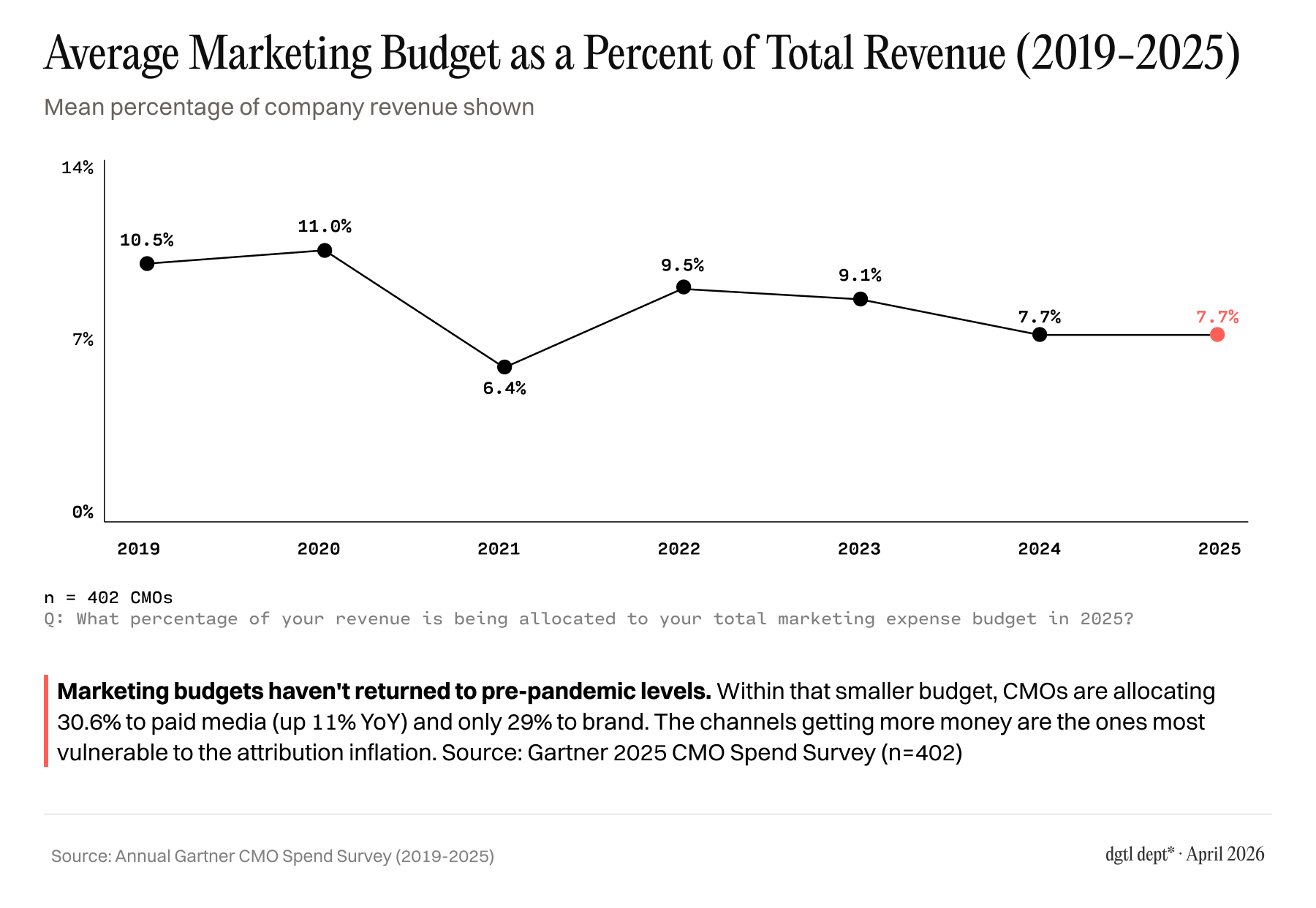
Binet and Field’s latest research, “Go Big or Go Home“ (IPA Effectiveness Conference, 2025), pushes further: AI has made digital activation so efficient that established brands should be shifting even more budget toward brand building. They warn of an “Efficiency Trap” where short-term ROAS keeps looking better while brand equity quietly erodes underneath it. If your blended ROAS has improved three quarters in a row but your repeat purchase rate is flat or declining, you’re probably in it.
Another doom loop, but this time it’s margin erosion disguised as optimization.
Soft Surroundings ran incrementality testing on their retargeting and found true CPA was multiples above what the vendor reported. The vendor had been selling them their own customers back. They cut retargeting 52%, reallocated to prospecting, and revenue went up 12% annually.
For sub-$5M single-channel brands where the entire funnel lives inside Meta, platform ROAS is less misleading because there’s less to misattribute, but it’s only a portion of the calculus you should be running to know how you’re actually performing.
The agents are coming
Bret Taylor stood on the Shoptalk stage last week and predicted that every retailer’s AI agent will become as important as its website. If the agent is the new storefront, every metric built on website behavior breaks. No website visit means no pixel, no session, no attribution.
A traditional e-commerce order generates 40+ measurable touchpoints: impressions, clicks, page views, cart events, session duration, referral source. An AI-agent-mediated purchase generates six: order ID, line items, total, timestamp, shipping address, payment method. That’s an 85% reduction in marketing intelligence. McKinsey projects $3-5 trillion flowing through that six-data-point channel by 2030.
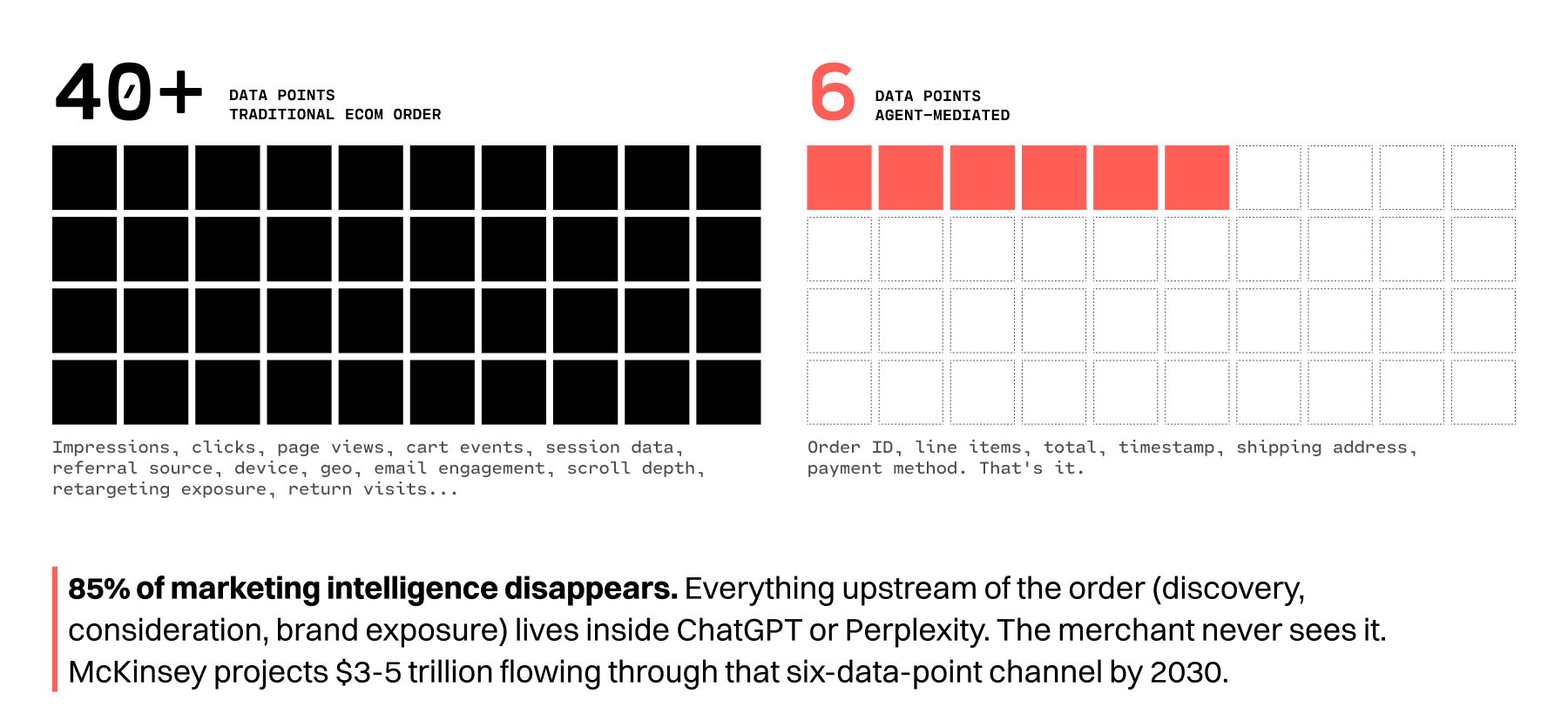
You can’t pixel a conversation inside ChatGPT. You can’t see which products the agent considered and rejected or whether your brand was in the consideration set. The entire attribution apparatus depends on visibility into the pre-purchase journey, and agents are privatizing it.
Kroger’s Christine Foster offered “If you know the cart, you know the heart” from the Shoptalk stage, but I would argue that’s a lagging indicator dressed up as wisdom. The whole point of ROAS was justifying the journey TO the cart, and agents are making that journey invisible.
Google is building the rails for agent-mediated transactions, but the infrastructure for measuring them doesn’t exist yet. Industry consensus puts reliable agent-commerce attribution at late 2027 at the earliest. Through at least next year, budgets will flow to channels most organizations can no longer measure.
The Measurement Philosophy
I’ve been in the hot-seat trying to explain incrementality to a board that only wants a ROAS number. I’ve also had too many conversations with CEOs and COOs who can’t let go of ROAS as the measure of marketing success. These conversations took longer than I anticipated, and though they were hard conversations to have, they were crucial — because the alternative is worse.
Only 35% of CMOs prioritize margin in their board reporting. The rest are still presenting in the language of channel-level ROAS because that’s the language the room often expects. And in doing so, performing a disservice to everyone in that room and their team back at home.
The fix is speaking in the same language as your P&L. I was calling it blended-ROAS back in 2017, before the industry settled on a name. Now it has one: MER.

Marketing Efficiency Ratio; total revenue divided by total ad spend. No attribution windows, no platform self-reporting, no double-counted conversions. When Meta changes an attribution setting and your channel ROAS drops 30%, MER doesn’t move, because revenue didn’t move. It’s a bank-account balance, and that’s the point.
But revenue alone doesn’t tell you enough, either. A brand doing $10M on $2M in ad spend looks efficient until you count COGS, shipping, returns, and customer service. Contribution margin (CM2 or CM3) forces the full accounting. CM2 includes variable costs. CM3 includes marketing spend. If your CM3 is negative, your growth is subsidized, and you need to know that before your next board meeting.

CAC payback period replaces LTV as the third metric because it’s concrete. Under three months is excellent. Three to six is decent. Over twelve is a conversation with your CFO about how long the balance sheet can fund acquisition before it pays for itself.


Behind the dashboard, the validation layer is a triangle: MMM for strategic budget allocation, incrementality testing for channel validation, platform attribution for daily tactical optimization. Each cross-validates the others. MMM is already the top-rated methodology among marketers, and Google dropped its incrementality testing threshold to $5,000 in late 2025. Meta’s open-source Robyn and Google’s Meridian have made in-house modeling viable. The old objections (too slow, too expensive) are dying.
For PE-backed brands, the play is even more concrete: run a two-week holdout test on branded search. Show the operating partner that $200K of “efficient” spend generated zero dollars in new revenue. Reallocate to prospecting that drives higher top-line growth on a shorter payback period. That’s a conversation a board can follow.
Come Monday, don’t wait
The next time someone presents a ROAS number, ask one question: what happens to that metric if we pause this channel for two weeks? Four?
If nobody can answer with data, you have a reporting habit masquerading as measurement. A measurement strategy worth building is one that survives when a platform changes the rules overnight, when an AI agent bypasses your website entirely, when the conversion your dashboard attributed to paid search was going to happen anyway.
Build the toolkit. Test the assumptions. Measure whether the business is actually growing, and how.
Let me know what you find.


Did you enjoy this newsletter?
Please like it by clicking on the ❤️ at the very top or bottom of this post. This really helps get this newsletter recommended to Substack’s recommended shortlists.
Or, if you enjoyed this, learned something new, and it will help you in any way, reply and tell me about it. If you loved it, you can always treat me to a coffee.