


Earlier this year I spent several months inside a brand whose martech stack had ballooned into chaos. 54 tools, most barely implemented. 124 automations live in the ESP, 30 of them actually running. Leadership wanting “show results this month” and “adopt AI” in the same meeting. You know this meeting.
The team wasn’t lazy. They were drowning. BAU demands — campaigns to ship, reports to pull, fires to put out, and the meetings, the meetings! — consumed every hour. I wrote the full diagnosis in The Fear Tax in February. Short version: most of the AI in your stack is reselling capabilities your platforms already have, and the teams buying it don’t have time to vet.

If you’re a marketing operator — fractional, in-house, running a team of two or a team of forty — your week likely looks similar. The Google Ads account you promised to “take a real look at” three weeks ago. The Klaviyo flows you know are under-built. The deck due Monday you haven’t started. The brand voice doc someone keeps asking for. In aggregate, they’re what’s pushing out the strategic work — and what’s making you quietly miserable on Sunday nights.
I was you twelve months ago.
Diagnosing the problem was the first half of the engagement. Trying to dig the team out was the second. I didn’t want to leave them with a diagnosis and a scorecard and walk. I wanted to leave them with tooling that could run the next audit without me in the room. The checklists I’d written over a decade of this work, the benchmarks I’d memorized, the diagnostic moves I made without thinking — if I could package that into something the model could load and update automatically, a team drowning in meetings wouldn’t have to rebuild it every time their CMO asked for a number.

That engagement ran me thin. But it also rewrote what I thought I was building. Every client engagement after tested one more piece of the system. The first time a scored audit fell out of an afternoon instead of a week, I felt the ground shift. These weren’t tools for me. They were tools for anyone doing this job. Starting with the team I’d just spent months inside.
What a skill is actually for
Claude Code shipped skills in 2.0; 2.1 turned the dial on iteration speed. Anthropic documented the primitive. The marketing layer on top of it — the marketing expertise layer — is the part I built myself and I’m giving to you.
Here’s the easiest way to feel what a skill is for. Ask Claude to “audit my Google Ads account” without a skill installed. You’ll get a generic checklist that could have come from any SEJ post. Or, more likely, “I don’t have access to that account.”
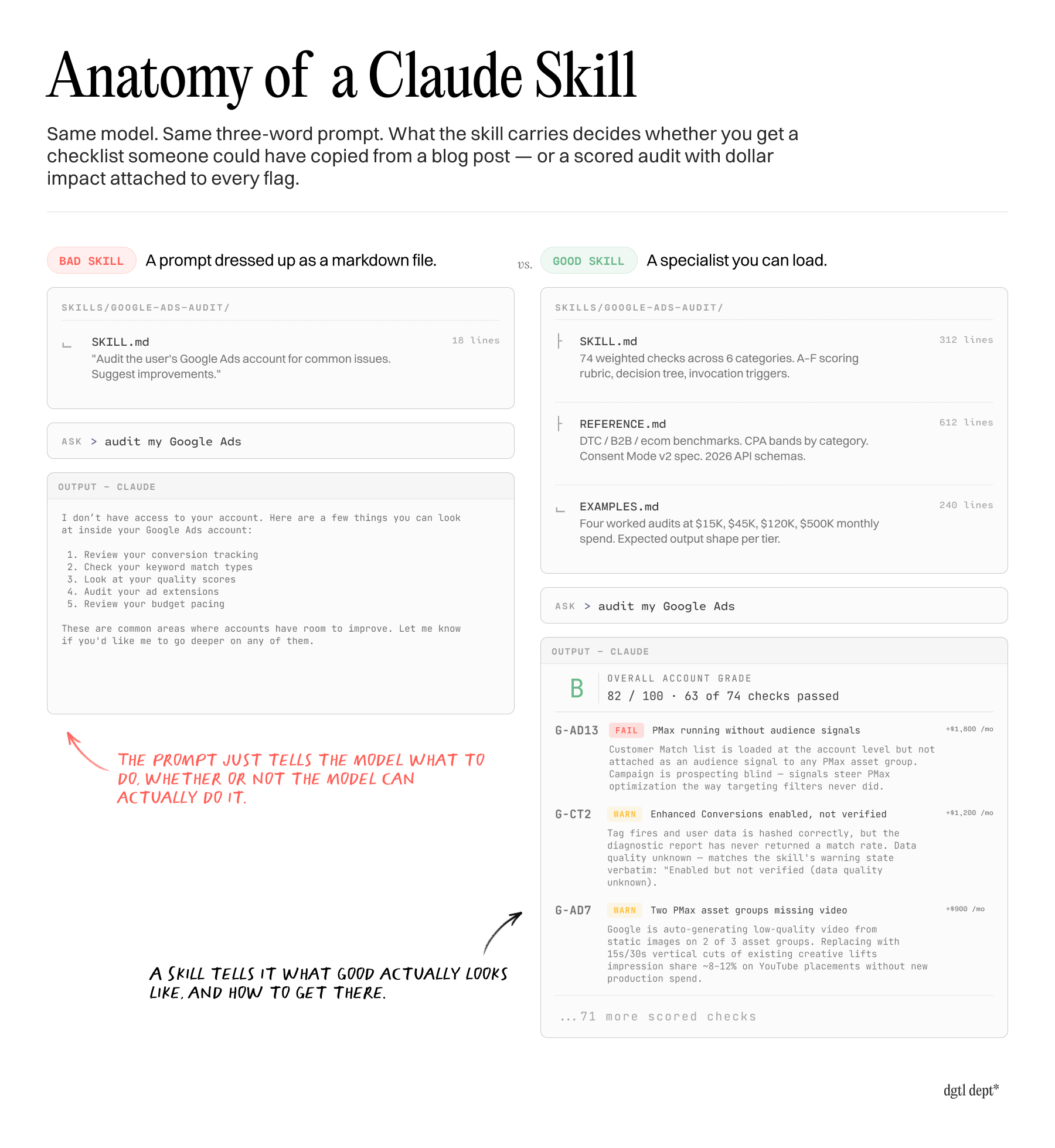
Install the Google Ads skill and ask the same question, and you get the scored audit back. From the hyper-technical (consent mode v2 gaps, enhanced conversions not verified) to the plain-English executive summary. Same model. Same prompt. Different output category entirely.
A skill is how you ship the operator’s judgment as reusable context. Technically, it’s a folder of markdown: SKILL.md (the framework and decision tree), REFERENCE.md (benchmarks, API schemas, rate limits, industry data), and EXAMPLES.md (worked prompts with expected output). When Claude sees a question that matches a skill’s trigger, it loads the skill automatically and uses it as context for the rest of the session.
What matters is what the skill carries. The reference material a specialist would reach for, loaded the moment the model hears the trigger. The model is the engine. The skill is the specialist. You’re still the judgement layer.
Why I built my own
I’ve been running scored audits for a decade. Google Ads. Klaviyo. GA4. Meta. Shopify. The checklists, the benchmarks, the diagnostic logic live in my head, in old decks, in my notebooks, in a few dozen Notion pages, in the shape of my weeks. Every engagement I’ve ever run has drawn from the same underlying (but constantly expanding) library.
I built the skills by packaging that library into files the model could load. Auditable in plain text, so the CEO signing off on the next tool can see exactly what’s in the box.
I looked at the open-source collections before I started. They weren’t it.
So I wrote from zero.
Paid media audits. Email flow reviews. Klaviyo event diagnostics. AI search scoring. Measurement audits. Market research. The work I’ve been doing for a decade, packaged so the next operator doesn’t have to reinvent the scorecard from scratch.
The repo has 50+ skills today. What could amount to $10,000 to $50,000 per month with an agency — all for the cost of a Claude subscription.
A week inside the system
Before I show you how, could you get most of this with a well-written prompt? I tried, for months, before I built any of this. A good prompt gets you maybe 30% of the way. The other 70% is what a skill ships alongside it: the reference file the model reads (benchmarks, industry data, rate limits, API schemas), the worked examples that show what good looks like, and the file-reading behavior that lets Claude compose across skills. When one skill says “reference the GA4 property you audited last week when we’re planning this campaign,” Claude Code does that in one turn. A prompt in a chat window asks you to paste the data or attach the PDF to the project.
The difference between a prompt and a skill is the difference between a wrapper and a specialist. The skills in this repo are on the specialist side of that line.
The most battle-tested are the three I run every week. Here’s the work, start to finish — the prompt I actually type, what comes back, and what that means for the engagement.
1. The Klaviyo Review
Klaviyo is where I often see the most money left on the table, and it’s also where most of my agency hours used to go. Flow completeness, segment health, campaign performance, deliverability — the same four phases, every time. The benchmark logic is what makes the scoring usable: what win-back revenue should look like for a DTC skincare brand driving $XXM/month via lifecycle, so the recovery math is grounded, not hand-waved.
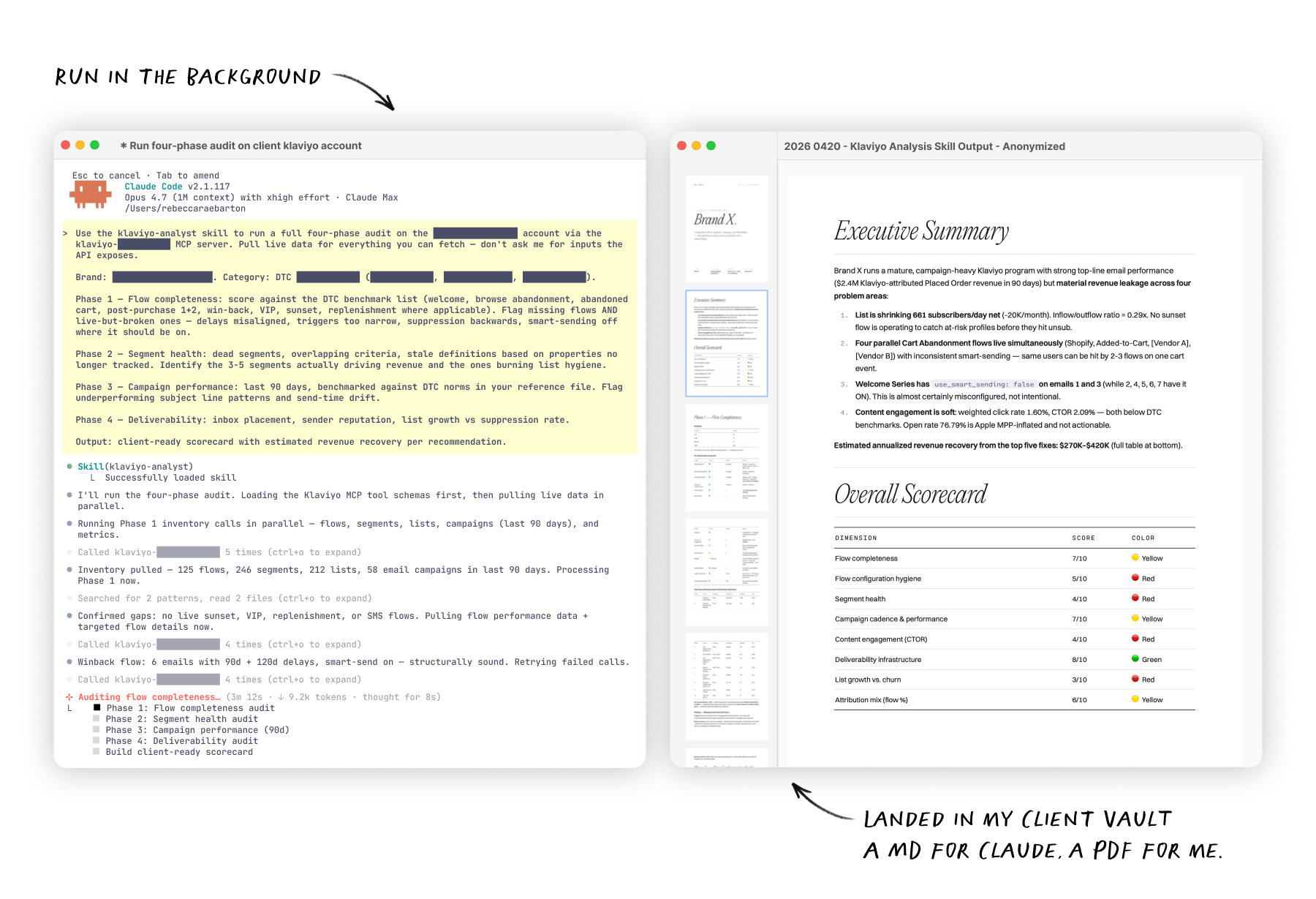
I run the four phases in sequence. Here’s the exact prompt, so you can steal it:
Audit my Klaviyo account for [brand]. [DTC / B2C / B2B] category: [skincare / apparel / home / accessories].

Phase 1 — flow completeness: score against the DTC benchmark list (welcome, browse abandonment, abandoned cart, post-purchase series 1+2, win-back, VIP, sunset, replenishment if applicable). Flag missing flows AND live-but-broken ones — delays misaligned, triggers too narrow, suppression logic backwards, smart-sending off where it should be on.

Phase 2 — segment health: dead segments, overlapping criteria, stale definitions based on properties the brand stopped tracking. Identify the 3-5 segments actually driving revenue
and the ones burning list hygiene.

Phase 3 — campaign performance: last 90 days, benchmarked against DTC norms in your reference file. Flag subject line patterns that are underperforming and send-time drift.

Phase 4 — deliverability: inbox placement, sender reputation, list growth vs suppression rate.

Output: client-ready scorecard with estimated revenue recovery per recommendation.
If you’ve ever paid an agency to audit your Klaviyo, you know the deliverable. The estimated-revenue-recovery line is the one that pays for the engagement. It used to be at least five days of work and a $5–10K line on the invoice, and now, it can run in ~15 minutes.
2. The Google Ads Audit
Every agency I worked with charged mid-five-figures for this deliverable, and the structure never really changed: seventy-odd checks across conversion tracking, wasted spend, account structure, Quality Score, ads, and targeting. What changed was who ran it, how long it took, and whether the scorecard was actually grounded in benchmarks for the category.
Here’s how I run one now. The minimal prompt is three words: audit my Google Ads. That loads 74 checks and returns an A-F health grade with priority-ranked remediation. For a real engagement, I type something closer to this:
Run a full scored audit of my Google Ads account.

Context: $45K/month spend, split roughly 40% Search, 25% Shopping, 35% Performance Max. DTC apparel. CPA has been creeping up 18% over the last 90 days and I suspect PMax is cannibalizing brand search.

Priorities: conversion tracking integrity first (enhanced conversions, consent mode v2, server-side), then PMax/brand cannibalization diagnosis, then wasted spend in non-brand.

Output: full A-F scorecard by category, prioritized remediation plan with estimated $/month impact per fix, and flag anything that needs platform access I haven't given you so I can pull it and re-run.
Same skill. More specificity in, more specificity out. To make the difference between a prompt and a skill concrete, here are the first four conversion-tracking checks, lifted verbatim from the skill’s check file:
G-CT1: Primary Conversion Action Exists [Critical, 5.0]
- Pass: Primary action exists and received conversions in last 30 days
- Warning: Primary action exists but 0 conversions in last 30 days
- Fail: No Primary Conversion Action configured

G-CT2: Enhanced Conversions Active [Critical, 5.0]
- Pass: Enhanced conversions active and verified
- Warning: Enabled but not verified (data quality unknown)
- Fail: Not enabled

G-CT3: Server-Side Tracking [High, 2.5]
- Pass: Server-side GTM or Google Ads API conversion import deployed and verified
- Warning: Planned but not yet deployed
- Fail: No server-side tracking (browser-only)

G-CT4: Consent Mode v2 (EU/EEA) [Critical, 5.0]
- Pass: Advanced Consent Mode active with proper CMP integration
- Warning: Basic Consent Mode only
- Fail: Not implemented despite EU/EEA targeting
And seventy more where that came from. A prompt tells the model what to do. A skill tells it what good looks like.
What comes back isn’t the check file itself — it’s a category-by-category scorecard, every failed check tagged with an estimated $/month impact and a priority label. The dollar estimates are what the CFO reads first. They’re also what makes the remediation plan land as a business case, not a tactical to-do. Five days of agency billables, compressed into the window between a Tuesday kickoff and a Thursday-afternoon review.
Take the file. It’s MIT, it’s public. Use it as your audit template even if you never install the skill. The check list is the same one I used at agencies that charged mid-five-figures for the same deliverable.
3. The AI search scorecard
AI search is its own discipline. ChatGPT, Perplexity, and Google AI Overviews pull from a different pattern of signals than Google blue links — structured data, citation density, claim-evidence grounding, llms.txt files. The scorecard translates those signals into something a content team can action. I’ve been running it on my own site since January.
Here’s the prompt I run per page:
Score [URL] for AI search citation readiness.
Target engines: ChatGPT, Perplexity, Google AI Overviews.

Score against all 8 dimensions of the AEO content scorecard: direct answers, data density, source attribution, structure, schema markup, freshness signals, author authority, quotability.

For every dimension scoring below 4/5, quote the current copy verbatim and rewrite it inline in the voice of the rest of the page. Do not generalize — show the exact before/after.

Flag missing schema types. If this is blog content, propose FAQ schema with 5 questions an operator in this space would actually ask. If it's a product page, propose Product schema with the attributes AI engines extract preferentially.

Close with a one-paragraph summary suitable for pasting into a client Loom.
This is the same scoring pass AI search agencies charge monthly retainers to run. The skill does a page in ten minutes — which means a full-brand pass across 20-odd priority URLs is a couple hours’ work. The inline before/after rewrites are the part that makes it deployable. Not just a diagnosis, but the copy the content team can ship on Monday.
Three disciplines. Paid media, email, AI search. A week of agency billable hours, condensed into a Tuesday afternoon.
Where the system scales
Three skills cover my MVPs, but there are 50+ more that I reach for when the work calls for them.
A DTC account lands on your desk Friday. Cross-Platform Audit merges Google, Meta, and Microsoft into one budget-weighted A-F grade by Sunday. Brand DNA reads the live site Monday morning and writes the voice profile the intake call would have taken three weeks to produce. Wasted Spend Finder runs Tuesday and hands you an uploadable exclusion list with categorized waste patterns. Pays for itself the first time you run it. Building a new outbound motion mid-week? ICP Research pulls voice-of-customer from Reddit threads, LinkedIn discussions, and podcast transcripts, and Cold Email & Outreach writes the sequence in your client’s voice once the personas are locked. Board deck due next Monday? Market Research produces a 50-page consulting-grade report (Porter’s Five Forces, PESTLE, TAM/SAM/SOM, competitive positioning) and the companion deck to present it.
Measurement lives in the same family. Google Analytics runs a GA4 property audit in twenty minutes — traffic trends, user behavior, performance bottlenecks, and a prioritized recommendations list with expected impact. Google Tag Manager surfaces duplicate tags, dead triggers, consent mode gaps, and, when you paste the GA4 output, the silent drift between what the container says is happening and what the analytics surface actually sees. Both are the kind of multi-day measurement-consultancy engagement the paid media audit used to be.
This is how you reclaim your time
I built the first skills inside a client engagement where the team was drowning in meetings and clunky processes. I’ve run the audits across my own practice every week since. The scorecards don’t care whose account they’re pointed at — the work shrinks either way.
The audit gets done. The weekend stays yours. The engagement you’d have declined — or the quarterly plan you’d have deferred — gets on the calendar. And occasionally, the opportunity you didn’t think was yours to take.
The work you didn’t have time for is on the other side of one afternoon.
The Claude Marketing Complete Guide walks you through each step of this process. It’s free, it’s in Notion, and it’s ready when you are.

This is free because I wish someone had handed it to me. If it helped, pass it on — share it to the work bestie who keeps saying they want to build something, or the marketing manager who really (really) needs the break.


Did you enjoy this newsletter?
Please like it by clicking on the ❤️ at the very top or bottom of this post. This really helps get this newsletter recommended to Substack’s recommended shortlists.
Or, if you enjoyed this, learned something new, and it will help you in any way, reply and tell me about it. If you loved it, you can always treat me to a coffee.