


*This article was originally published on rebeccaraebarton.com

I’ve been thinking about moats lately. The competitive kind. The Warren Buffett kind — the durable advantages that keep customers coming back and competitors at bay.
The traditional moats in consumer brands are eroding. Product differentiation gets copied in months, if not weeks or days. Proprietary distribution deals are harder to lock up. Scale advantages matter less when a Shopify store can look as polished as a Fortune 500 brand. Even data moats — all that first-party information we all scrambled to collect when the cookies started crumbling — turn out to be less defensible than advertised when everyone has access to the same AI tools to analyze them.
So what’s left? What actually protects a brand when the structural advantages are gone?
I keep coming back to the same answer: trust.
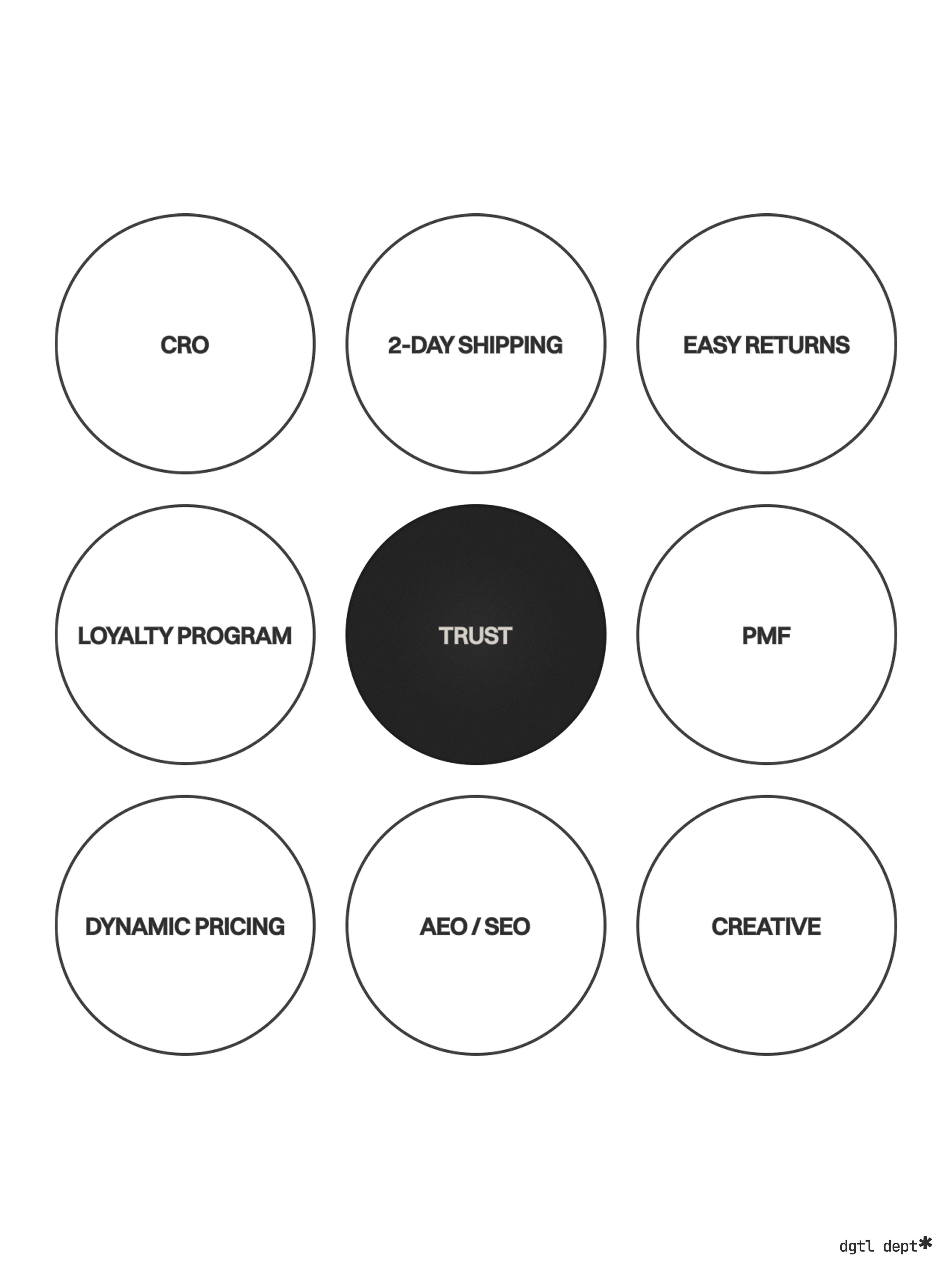
Not trust as a brand attribute. Not trust as something you claim in your marketing copy. Trust as an operational reality. The actual experience of being trustworthy, delivered consistently, at every touchpoint, over time.
It sounds soft. It isn’t.
Edelman has been measuring trust for over 25 years, and their 2025 data is brutal. Sixty-one percent of consumers hold grievances against business and government. Seven in ten believe leaders purposely mislead them. Trust inequality — the gap between how much high-income and low-income people trust institutions — is at record highs. We’re living through what they’re calling a “crisis of grievance,” and brands are not exempt from it.
Here’s the number that should keep you up at night: 69% of people believe business leaders deliberately mislead them — up 11 points since 2021. And they trust your regular employees more than your CEO. Let that sink in.
This isn’t abstract. It shows up in behavior. When trust is low, customers hedge. They wait for sales instead of buying at full price. They read the return policy before the product description. They screenshot the checkout page in case they need to dispute the charge later. Every interaction carries a thin layer of suspicion that adds friction, reduces conversion, and compresses lifetime value.
When trust is high, the opposite happens.
Customers give you the benefit of the doubt. They try new products without obsessive research. They forgive mistakes. They tell their friends. The entire economics of customer acquisition shift because you’re not fighting against skepticism at every turn.
Most brands understand this intellectually. Very few build for it operationally.
Building for trust means making decisions that hurt in the short term. It means a return policy generous enough that some people will abuse it. A customer service team empowered to solve problems without escalation scripts. Shipping estimates that are conservative rather than optimistic. Honest product descriptions that acknowledge limitations instead of burying them in fine print.
It means not running the “FINAL HOURS” email when it isn’t actually final. Not pretending the discount is exclusive when it isn’t. Not manufacturing urgency that doesn’t exist. Every one of those tactics works in the short term and erodes trust in the long term. Every one of them is standard practice at most brands I’ve worked with.
The irony is that this is happening just as trust becomes more important than ever. Think about agentic commerce — AI agents shopping on behalf of consumers. What signals will those agents use to make decisions? They’ll use reviews, ratings, return rates, dispute frequency, response times. They’ll use the quantifiable residue of trustworthiness. The brands that have been cutting corners, gaming reviews, making returns difficult — that stuff is going to show up in the data. And the data is going to be what the algorithms see.
But even before the AI agents take over, trust matters more because everything else matters less. When every brand can run sophisticated personalization, personalization isn’t a differentiator. When every brand can offer fast shipping, fast shipping isn’t a differentiator. When every brand can produce decent content at scale, content isn’t a differentiator. The features that used to create separation are now table stakes.
What’s left is the relationship. The accumulated experience of a thousand small interactions that either build trust or erode it. Did the product match the photos? Did the email frequency respect my attention? Did customer service actually solve my problem or just read from a script or worse, did an AI chatbot support agent give me bad info? Did the brand do what it said it would do?
This is where I see a disconnect in how most brands operate. The people responsible for trust-building activities — customer service, fulfillment, product quality — are usually in cost centers. They’re measured on efficiency, not effectiveness. Their budgets get cut when times are tight. Meanwhile, the people responsible for customer acquisition — marketing, growth — are in revenue centers. They’re measured on volume. They get the investment.
The result is predictable. Brands spend heavily to acquire customers and then systematically underinvest in the experiences that would make those customers stay. They optimize the top of the funnel and neglect the middle. They treat trust as an externality — someone else’s problem, or nobody’s problem, or a problem for later.
Later is now.
I’m not arguing for softness. I’m arguing for strategy. The brands that will win in the next decade are the ones that recognize trust as a hard asset and invest in it accordingly. That means different metrics — tracking trust indicators alongside acquisition indicators. It means different org structures — giving trust-building functions real authority and real resources. It means different incentives — rewarding retention and customer satisfaction, not just new customer volume.
And it means being honest with yourself about where you actually stand. Not where your brand tracking study says you stand. Where your return rate says you stand. Where your customer service ticket volume says you stand. Where your repeat purchase rate and your NPS and your LTV and your actual, observable customer behavior say you stand.
Trust isn’t a moat you can build with marketing. It’s a moat you build with operations. With decisions. With the thousand small moments where you choose between what’s easy and what’s right.
Most brands are choosing easy. That’s what makes trust a moat. Because the gap between claiming to be trustworthy and actually being trustworthy is wide, and most of your competitors are on the wrong side of it.
The only moat left is being the brand that does what it says. It’s not complicated. It’s just hard. And hard is where the value is.
