


I imagine your Monday mornings may look a little like mine.
It’s 8:47am and I’ve just gotten back from walking the dog. I make myself a fresh cup of tea (maybe you have coffee). I sit down at my desk and start going through the motions. I start a playlist, re-check my calendar, make sure my to-do list is in order, and while my usual smattering of apps open and load, I check LinkedIn.
The first three posts in the feed:
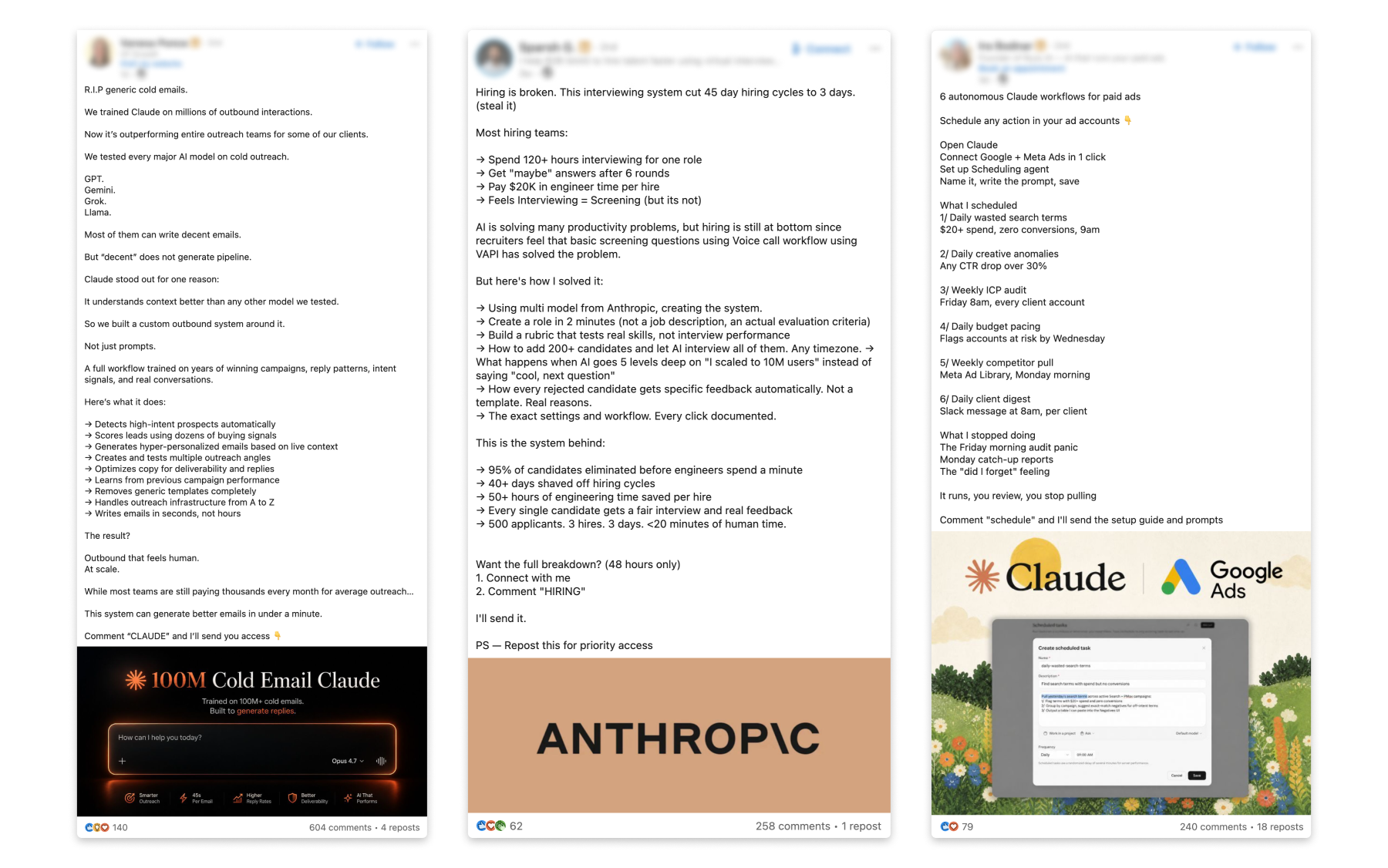
I scroll. There’s another. And another, and another.
I close the app.
Honestly, the part that irks me isn’t the claim that AI is doing all of these things (most of it is fantasy, anyway). It’s the earnest “wow how did you do that” replies, the hundreds of “CLAUDE” comments, the author’s reply itself written in the cadence of an LLM, telling the commenter to send a connection request in exchange for a four-step “playbook” that’s… not.
The algorithm cannot tell the difference between someone who has run the job and someone who has never been near it, but it rewards one more than the other.
AI gave the second person just enough fluency to write a post about a job they never did. The algorithm gave that post just enough reach that the people who have done the job are starting to wonder if they’re the ones missing something.
AI, fine. Productivity claims, sure. But the active, deliberate misleading of others — crowding the feed so much that veterans who have actually done the work start to question their own pattern recognition — that makes me want to hurl my laptop into the East River.

So this week, I'm not sharing yet another opinion about AI. AI is changing how the work gets done, whether we like it or not. What's missing from everything in my feed is the requirement to level up, not outsource. Know more than the AI, not less. Be the operator the model can't replace, instead of the operator the model is being sold to replace.
The four fractures
Let’s start with what we can measure.
Last fall, BetterUp Labs and Stanford Social Media Lab ran the research in HBR. 41% of U.S. full-time employees received workslop in the last 30 days. The average instance costs 1 hour and 56 minutes of cleanup. Almost two hours, per discrete piece of slop, trapped in the cycle of reviewing, correcting, and redoing.
That works out to $186 per employee, per month in lost productivity. For a 10,000-person organization: over $9M a year, in cleanup alone.
I read that and felt validated. Then immediately, a little annoyed.
Because if we’re being honest, the cost of cleanup is likely 3-4x what HBR reported and because the BetterUp study names only the symptom. It is silent on the mechanism. And the mechanism is what determines whether this is a transition cost or a permanent fixture.
There’s also the matter of ROI: 95% of organizations report no measurable return on generative AI investment, and 42% of pilots have been abandoned at the proof-of-concept phase. That is a lot of cleanup for a payoff that is, statistically, not arriving. Earlier this year I wrote about what $300 billion worth of AI shelfware actually bought, but the cost of workslop is an operating expense of the very same purchase.
Even Microsoft’s vice chair Brad Smith has gone on record saying AI answers should be interrogated with the same skepticism you’d apply to directions from a stranger on the street.
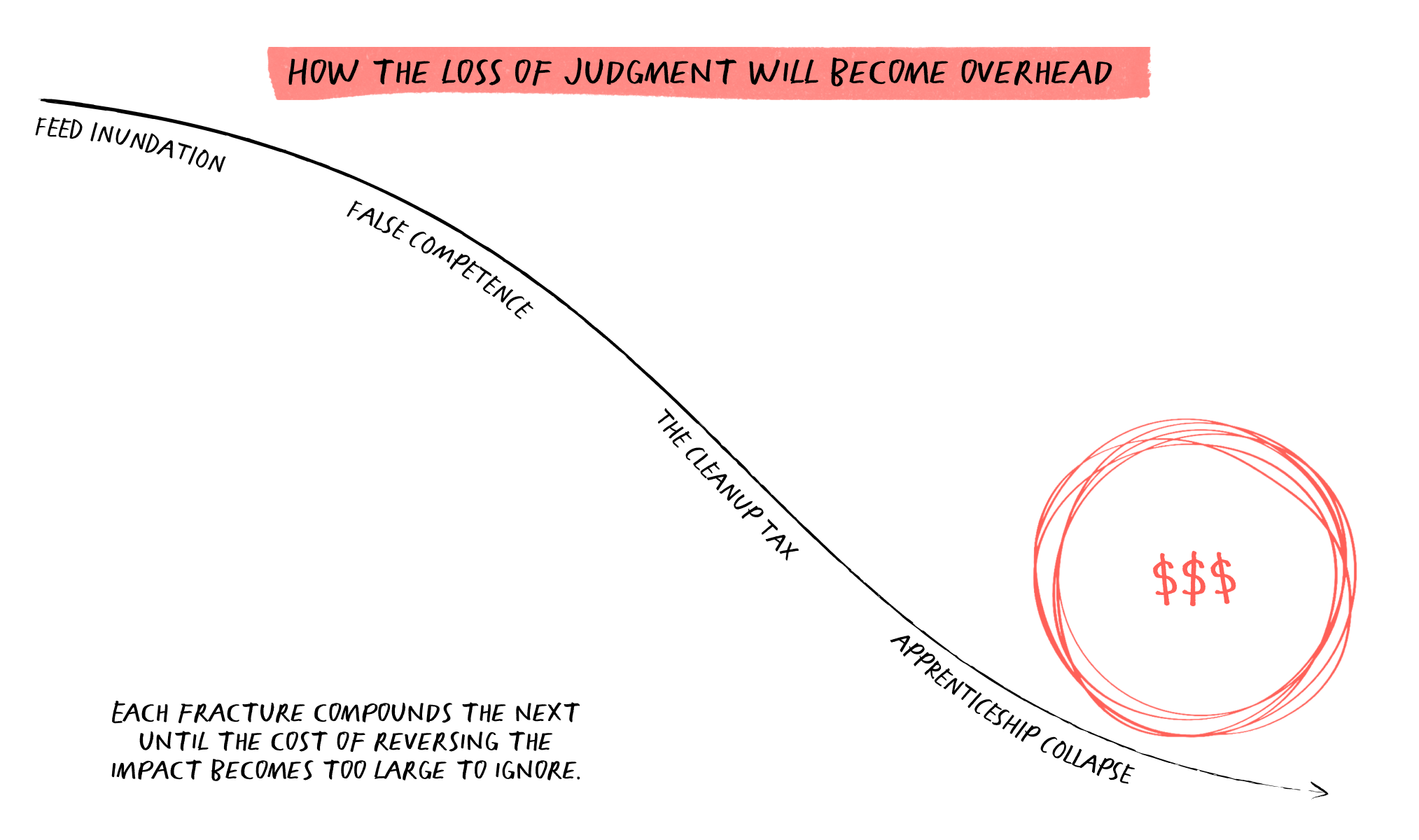
So here’s what I see actually happening, in four parts.
Feed inundation. The same dynamic plays out on LinkedIn, Instagram, Twitter, Substack, and TikTok. The algorithm rewards confident-sounding artifacts. AI produces confident-sounding artifacts at zero marginal cost. The loudest voices in our feeds end up being the ones with the least underlying judgment, because those who actually do the work are too busy doing the work to post six times a day about how easy it is — because it isn’t.
False competence. AI gives unskilled operators a feeling of competence they do not have. The artifact arrives looking finished — the strategy deck, the email brief, the campaign analysis — and the author cannot tell whether it’s good. At the peak of Mount Stupid they’re blithely unaware they couldn’t have written it themselves, and they have no internal model to evaluate it against. They ship it.
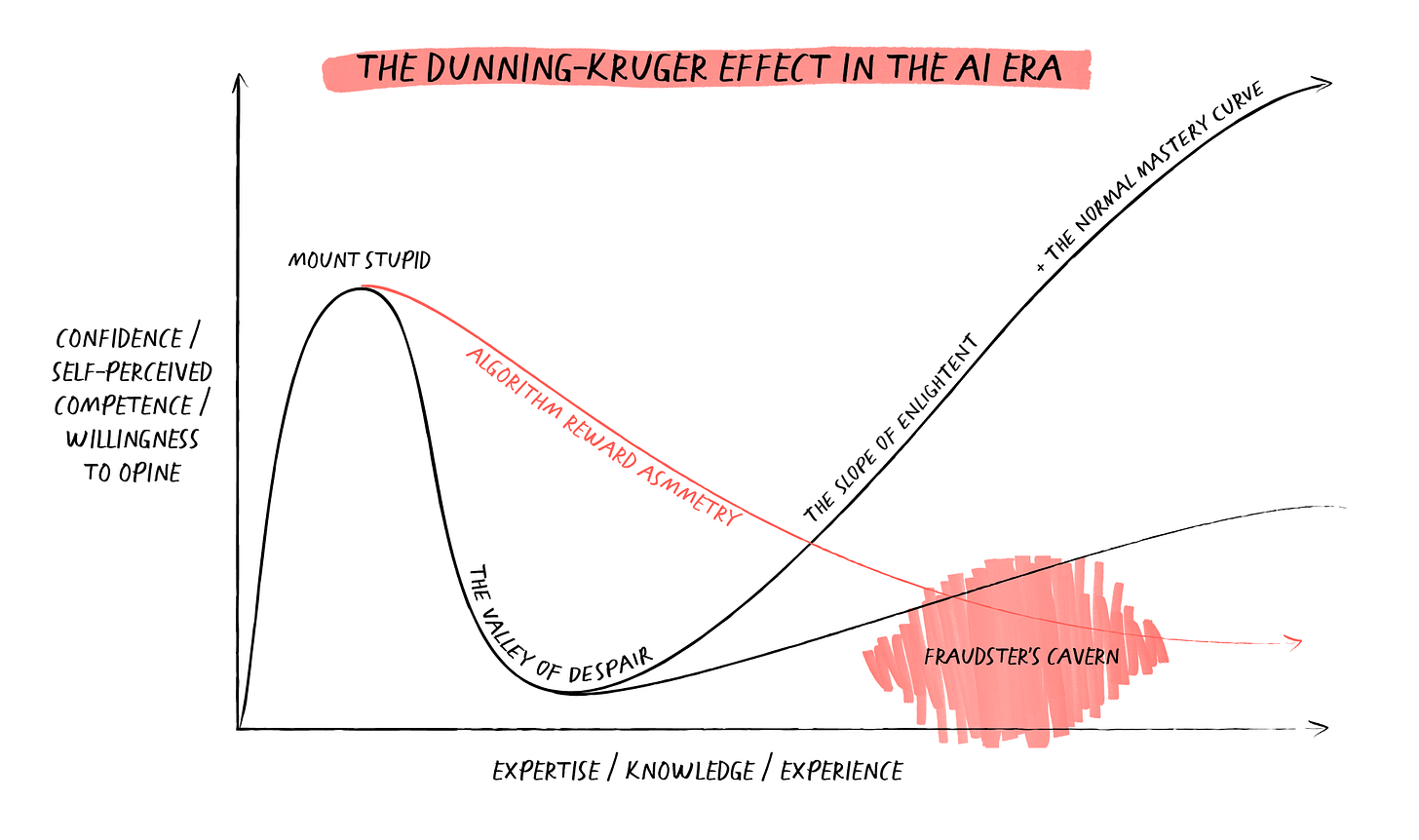
The standard mastery curve, and where competent operators get conned by Mount Stupid noise. The cleanup tax. The senior in the workflow is the person who can tell (or at least, should be). So they become the verification layer. Every AI-drafted brief lands in their queue, every AI-generated dashboard gets pasted into a doc and sent up for review, and the senior’s calendar gets eaten by the work of catching all that the AI missed. This is the part HBR measured. Compounded across a marketing team running a dozen or more AI workflows a day, that’s the entire week in review.
Apprenticeship collapse. And this is the part so few pricing in. The job that taught me, taught you, to do this work is the role getting deleted first: the lifecycle coordinator, the paid search analyst, the merchandising assistant. It’s the role that now has an AI agent attached to it. The work is still happening, but the learning isn’t. There is no junior in the room watching the senior decide.
These are not four separate problems, but the same problem at four points in the slide.
The trajectory is hostile
Pull on any of those four fractures and you’ll find the same bet underneath. It lands in your work every day, well beyond the LinkedIn feed.
The exec mandate says: we’re cutting production time by 50%. Translated: the verification step is overhead, please absorb it into your existing capacity.
The engagement algorithm says: we cannot tell the difference between something written by someone who has done the work and one written by someone who hasn’t, and we will reward whichever one keeps users on the platform. Translated: judgment is invisible to us, and we don’t care.
The PE/efficiency playbook says: the analyst seat, the lifecycle coordinator seat, the paid search assistant seat. These are expendable headcount. Automate them. Translated: the seat where judgment was forged is the seat we are eliminating first.
The vendor pitch says: skip the expert. Klaviyo’s Generative AI Subject Line Generator, Shopify’s Sidekick, HubSpot’s Breeze, take your pick. Translated: the artifact is the product. The judgment behind it is a feature you don’t need.
Same mistake, four venues. Judgment is being priced out.
That’s the cost of workslop — not the dollar figure HBR put on it, but the structural decision underneath. We have collectively bet that the artifact and the judgment are separable. That you can keep the deck and skip the person who learned how to read one. That you can keep the campaign and skip the human who knows when it’s bullshit.
That bet is wrong, and it gets more wrong as the artifacts get better.
The optimist’s argument is that this is a phase. Better models (Opus 4.7, GPT-6, whatever ships in eighteen months) will eliminate hallucinations. The slop will get better. The verification cost will drop.
I do not think that is what is happening. I think it gets worse.
As models improve, the artifact gets more polished. The errors get subtler. The deck looks more like a real strategy deck. The campaign analysis reads more like a campaign analysis written by someone who has actually run a campaign. The verification cost does not go down. It goes up, because the surface is harder to read.
The false-competence effect accelerates with it. The mediocre operator’s output looks more competent at a glance, which means more of it ships, which means the manager’s queue gets longer, which means the apprenticeship rung — already shaky — falls further out of reach. The artifact looks “good enough” to skip the apprentice entirely.
Klarna learned this in public. The company eliminated roughly 700 customer service positions through 2024, replacing them with an OpenAI-built assistant, and CEO Sebastian Siemiatkowski told CNBC the AI was doing the work of 700 people. By early 2026, the company was quietly rehiring. CSAT had cratered on complex interactions. “We went too far,” Siemiatkowski admitted. The projected savings hadn’t materialized — handling the quality failures consumed more than the automation saved. The reversal is the cleanup tax made fiscal.
And the human-in-the-loop premise breaks under its own weight. The comforting fiction was that we could keep the human as a quality gate while AI did the volume. If judgment is the product, you cannot scale the human out of the loop without scaling the product out of the product. Every “agentic AI” pitch I’ve seen so far assumes you can. Every executive I know who’s tried it has discovered you cannot.
Earlier this year I wrote about Elena Verna’s framing of AI as “average intelligence”. Not artificial — average. AI does the work that’s already been done enough times that a pattern exists. It handles the mean. It cannot, structurally, do the work that produces seniority. Because that work is getting things wrong on the way to getting them right, and an AI optimized for plausibility is the worst possible coach for that journey.
No juniors, no seniors
If the lifecycle coordinator role is gone, where does the next Director of Lifecycle come from?
If the paid search analyst seat has an agent in it, where does the Head of Paid Acquisition learn how to read a Google Ads account?
If the merchandising assistant is “AI-enabled,” meaning replaced, what happens in 2032 when the VP of Merchandising retires?
The math isn’t subtle. Senior operators were juniors once. We were interns. We were dumb before we were smart. We had bad ideas before good ones. The repetitions that produced high-caliber specialists happened in a seat that is now being deleted: the wrong call you got coached through, the campaign that bombed and your boss walked you through the post-mortem, the eight-hundred-and-fortieth subject line that taught you something the first one couldn’t.
You learned.
The AI is producing the artifact without the learning. Which means the artifact gets cheaper and the talent pipeline behind it dries up.
This is not moral-panic mode. The data is already showing up. Anthropic’s own labor-market research found that hiring of workers aged 22-25 into AI-exposed occupations has slowed by about 14% since ChatGPT launched, attributable primarily to a slowdown in hiring rather than an increase in layoffs. SignalFire reports new graduate hiring at major tech firms has fallen by more than 50% since 2019, with fresh graduates now making up just 7% of new hires. Fortune reports entry-level hiring rates dropped 73.4% in Q2 2025, against 7.4% across all levels.
The front door is narrower. The lower rungs getting chipped away. The mid-level managers and ICs who were supposed to be next in line are not even in the building.
If you are reading this, you might be the last cohort that learned the craft the way it has to be learned. Through reps. Muscle memory. Lived experience. Through being wrong out loud, through someone senior catching it and telling you what and why.
That seniority — the kind you cannot prompt your way into — is about to be the most undersupplied asset on the org chart.
What I'm betting on
Earlier this year, I shipped the Marketing Expertise Layer for Claude Code, which applies a decade’s worth of experience as a framework around an AI agent so teams using it can run with the judgment, not as a substitute for it. The Layer exists because I think the cleanup tax is real and permanent, and because marketing and e-commerce operators need infrastructure for directing AI, not just absorbing its output.

That’s the bet I’m making with my own time: AI accelerates the work when there’s applied knowledge to harness it, and proliferates the mess when there isn’t. That’s what the layer is, a harness.
If you’re nodding along, the same bet is available to you. Four positions, held together or not at all, in order of how uncomfortable they get:
Be skeptical. The 50-agent CRO team. The marketing department built in 58 minutes. The hiring cycle that went from 45 days to three by having AI interview candidates. If it sounds too good to be true, it is. Apply the same skepticism upstream of your work — to the vendor pitch, the AI-generated dashboard, the consultant deck, the campaign analysis a junior generated with a prompt. Develop the vocabulary to push back on what you’re being sold. This one is free.
Refuse the unstated mandate. When the exec ask is “use AI to ship faster” without a corresponding “and here’s the verification capacity that requires,” that’s not an AI strategy. That’s a cleanup tax against your time and sanity. The pushback isn’t dramatic, just specific: if we need this output at this volume, here is what verification and continuing education actually cost, and here is how we’ll pay for them. Make the invisible work visible in the budget conversation. This one will make you unpopular for a quarter.
Call out the slop in your inbox. When a colleague forwards you an AI-generated brief that doesn’t pass a basic read, do not silently rewrite it. Hold the line. Send it back, politely, specifically, in writing: this needs a human pass before it can go any further. You’ll be the difficult one for a week or few. The alternative is worse: a culture where nobody checks because checking is too awkward.
Defend the rungs below. Hire the junior. “But the junior is expensive. AI is cheap.”The work the junior used to do can be automated.” I know. Do it anyway, despite all the arguments against it. Run the meeting where they get to be wrong out loud. Walk them through the post-mortem on the campaign that bombed. Show them how you read the Klaviyo flow and why it matters. Build a case for the headcount that names what you’re buying: not labor at the bottom of the org chart, but a senior leader in 2032. They’re the expensive one. They’re the one that matters.
None of these will feel like enough on a Tuesday afternoon, I know. The frustration is structural. The exec mandate isn’t going away. The algorithm doesn’t care. The vendor will keep selling “skip the expert” as a feature. The PE spreadsheet can’t quantify judgment until you define the value.
Tomorrow at 8:47am, the feed will look the same. Close the app. Cut the bullshit. Do the work. Hire the junior.


Did you enjoy this newsletter?
Please like it by clicking on the ❤️ at the very top or bottom of this post. This really helps get this newsletter recommended to Substack’s recommended shortlists.
Or, if you enjoyed this, learned something new, and it will help you in any way, reply and tell me about it. If you loved it, you can always treat me to a coffee.